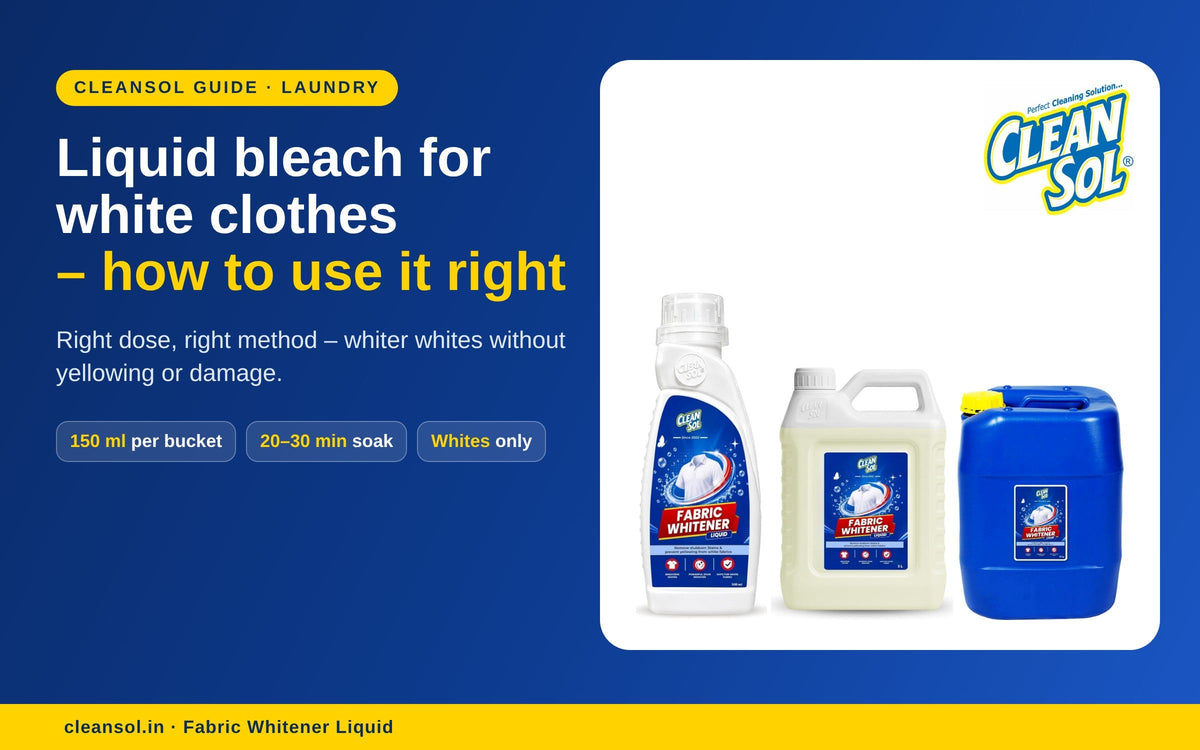
Cleansol Guide · Laundry
How to use liquid bleach on white clothes – whiter whites without yellowing or damage
School shirts gone grey, vests turned yellow, towels and bedsheets that never look fresh – liquid bleach is the fastest way to bring white cotton back. Used the wrong way, it can also make whites more yellow or weaken the cloth. Here is the right dose, the right method and the mistakes to avoid – at home and in commercial laundries.
150 ml
per bucket of 8–10 L
20–30 min
soak, no longer
Whites only
cotton, linen, terrycot
Rinse twice
no yellowing later
Quick answer: Wash or rinse the clothes first, then mix 150 ml of liquid bleach in 8–10 litres of normal tap water. Soak only white cotton, linen or terrycot for 20–30 minutes, rinse well, then wash with detergent. Never pour bleach neat on fabric, never use it on colours, silk or wool, and never mix it with acids or toilet cleaners.
In this guide
Liquid bleach dose chart
| Use | Water | Liquid bleach | Time |
| Bucket soak – dull or grey whites | 8–10 L | 150 ml (3 cups) | 20–30 min |
| Heavy stains or very yellow clothes | 5 L | 100 ml (2 cups) | 20–30 min |
| Washing machine, one load | Machine water | About 60 ml | Normal cycle |
| Single stain | 1 mug | 50 ml (1 cup) | 15–20 min |
| Commercial laundry – light soil | Bleach bath | 5–10 ml per kg dry linen | 8–10 min |
| Commercial laundry – medium soil | Bleach bath | 10–15 ml per kg | 8–10 min |
| Commercial laundry – heavy soil | Bleach bath | 15–20 ml per kg | 10–12 min |
Doses for Cleansol Fabric Whitener Liquid (chlorine-type laundry bleach). The 1 L bottle comes with a 50 ml measuring cup. Start with the lower dose – more is not better.
Why white clothes turn yellow and grey
White cotton does not change colour on its own. It slowly collects things that ordinary washing leaves behind – and each one needs a slightly different fix.
💧 Sweat & body oil
Collars, cuffs and underarms collect body oil that oxidises into a yellow film. Wash these well before bleaching.
🧼 Detergent residue
Too much detergent or too little rinsing leaves a greyish film that dulls whites.
🪨 Hard & iron-rich water
Minerals and iron in borewell water give a dull grey or rusty-yellow tint over time.
🍛 Food & drink stains
Tea, coffee, juice and curry leave coloured marks that bleach lifts out of white cotton.
🌧️ Damp storage
Clothes kept damp develop mildew spots and a musty smell.
♨️ Too much bleach or heat
Overdosing bleach or using very hot water can itself turn cotton yellow and weaken it.
Is liquid bleach safe for your fabric?
| Fabric | Liquid bleach? | Use instead |
| White cotton, linen, terrycot | ✅ Yes | – |
| White poly-cotton uniforms | ✅ Yes, lower dose | – |
| Coloured or printed clothes | ❌ No – fades and patches | Oxygen bleach |
| Silk, wool, pashmina | ❌ No – damages fibre | Mild detergent, care label |
| Nylon, lycra/spandex, sportswear | ❌ No – weakens and yellows | Oxygen bleach (if colour-fast) |
| Leather, delicates, dry-clean only | ❌ No | Professional cleaning |
If unsure, test on a hidden seam for 5 minutes and check for colour change.
Bucket soak – step by step
1 · WASH FIRST
Wash or rinse the clothes to remove sweat, body oil and loose dirt. Bleach works better on clean fabric.
2 · MIX
Fill a plastic bucket with 8–10 L of normal tap water. Add 150 ml bleach and stir. Add bleach to water – never water to bleach.
3 · SOAK
Push white clothes fully under water. Soak 20–30 minutes. Do not leave overnight.
4 · RINSE & WASH
Rinse twice in clean water, then wash with detergent and dry in the sun.
🧤 Wear rubber gloves and use a plastic bucket – not a metal one. Keep the room airy.
Washing machine and single stains
Front-load and fully automatic machines: pour about 60 ml into the bleach compartment. If your machine has none, dilute 60 ml in 1 litre of water and add it after the drum has filled. Run the normal cycle with an extra rinse.
Top-load and semi-automatic machines: fill the tub, add the diluted bleach, then add the white clothes. Wash, then rinse twice.
A single tea, coffee or juice stain: mix 1 measuring cup (50 ml) in a mug of water, soak only the stained area for 15–20 minutes, rinse and wash.
Never pour bleach straight onto dry clothes. Neat bleach leaves pale patches, yellow spots or even holes in cotton.
Hotel, hospital and commercial laundry linen
In a commercial laundry, bleaching is a separate, measured step after the main wash – not mixed into the detergent bath.
| Stage | What to add | Cleansol product |
| Main wash | Detergent (+ booster for oily linen) | Ultra Detergent · Laundry Booster |
| Rinse | Clean water | – |
| Bleach step | 5–20 ml per kg dry linen, warm (not hot) water, 8–12 min | Fabric Whitener Liquid |
| Rinse ×2 | Clean water | – |
| Last rinse | Sour to neutralise leftover chlorine & alkali | Fabric Sour |
| Optional | Extra blue-white tint | Liquid Blue |
Very hot water makes chlorine bleach break down fast and can yellow cotton. Keep the bleach bath warm, not hot.
🧺 Exact doses for your machine: try our free laundry dosing calculator for detergent, booster, bleach, sour and softener. Full process: commercial laundry process, step by step.
Liquid bleach vs oxygen bleach vs bleaching powder vs neel
| Liquid bleach | Oxygen bleach | Bleaching powder | Neel / liquid blue | |
| What it does | Removes stains & yellowing | Removes stains, gentler | Removes stains | Adds blue tint only |
| Whites | ✅ Best, fastest | ✅ Good | ✅ but must dissolve fully | ✅ tint only |
| Colours | ❌ No | ✅ Most colour-fast | ❌ No | ❌ No |
| Water | Normal tap water | Warm water best | Normal water | Last rinse |
| Ease of use | Easy, measured liquid | Easy powder | Must dissolve, can leave grains | Easy |
| Best for | Very yellow or stained white cotton, hotel linen | Regular whitening, mixed loads | Water tanks, toilets, drains | Final rinse touch |
Read more: Oxygen bleach for clothes – how to use.
Mistakes that make whites yellow (or damage them)
- Using too much bleach – it weakens cotton and can leave a yellow tint. Measure with the cup.
- Bleaching dirty, sweaty clothes – chlorine reacts with sweat and body oil and can deepen yellow underarm marks. Wash first; treat sweat stains with oxygen bleach.
- Soaking overnight – 20–30 minutes is enough; longer only weakens fibres.
- Not rinsing enough – leftover chlorine yellows after ironing. Rinse twice.
- Hot water – use normal or warm water, never boiling.
- Metal buckets – use plastic.
- Iron-rich borewell water – bleach plus iron can leave rust-yellow spots. See how to remove rust stains from clothes.
Safety rules for liquid bleach
Never mix liquid bleach with acids, toilet cleaners, tile or bathroom cleaners, vinegar or ammonia. The mixture can release harmful gas. Use bleach on its own and rinse buckets before switching products.
- Wear rubber gloves; avoid eyes and skin. If it splashes in the eyes, rinse with plenty of water for 15 minutes and get medical help.
- Use in a well-ventilated area.
- Keep out of reach of children and pets. Not to be swallowed.
- Store tightly closed, upright, in a cool, dark place away from sunlight. Use within 12 months of manufacture for full strength.
Frequently asked questions
Cleansol Fabric Whitener Liquid
Chlorine-type laundry bleach for white clothes · works in normal tap water · 1 L bottle with measuring cup, 5 L can, 25 kg can.
Shop Fabric Whitener → Oxygen Bleach for colours →Related: How much detergent per kg of clothes · How to remove oil & grease stains · Commercial laundry process
Always follow the garment care label and the product label. Keep laundry chemicals away from children and pets. Bulk orders: WhatsApp 98290 05860.