Hover over image to zoom
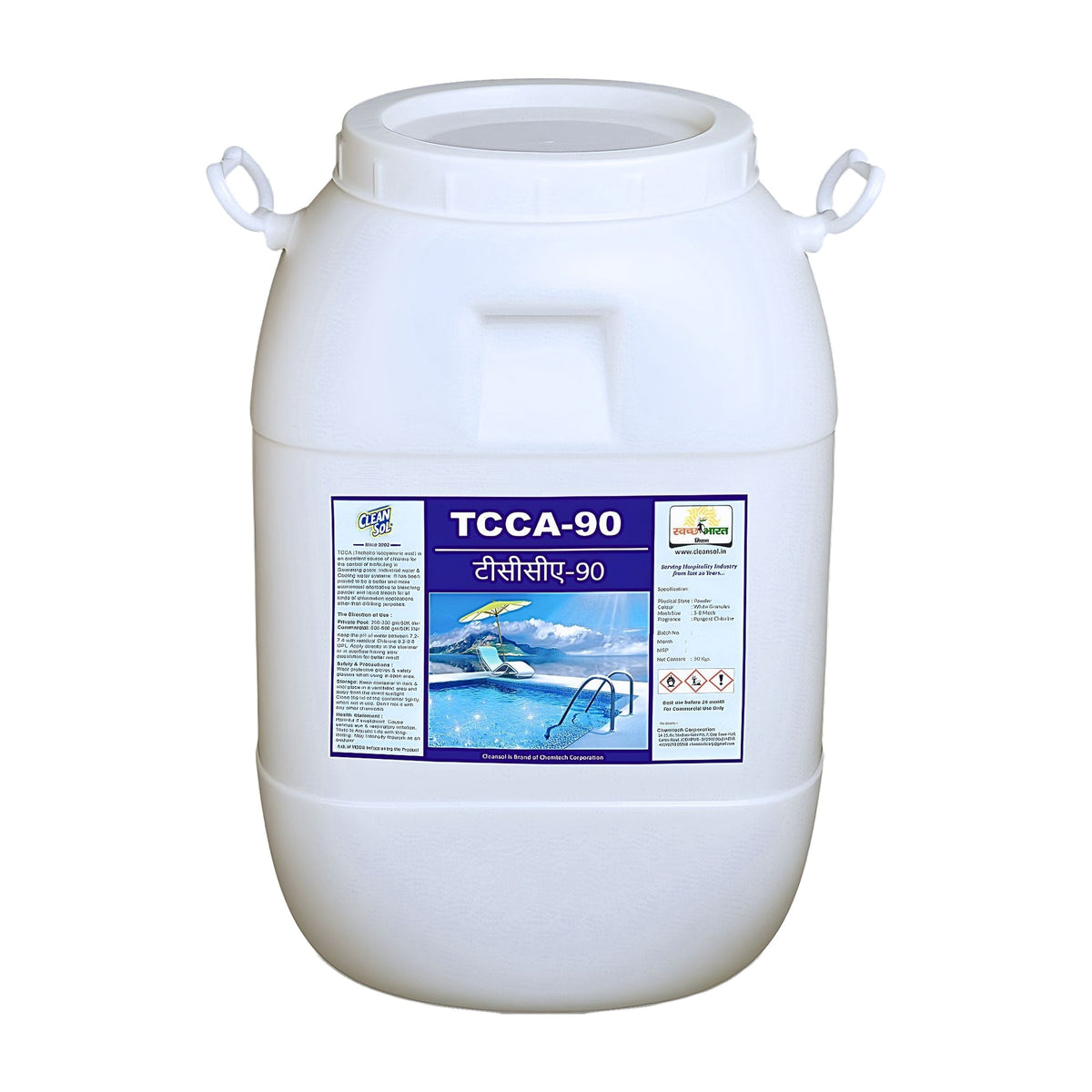
Cleansol TCCA 90 Chlorine Granules
About this item
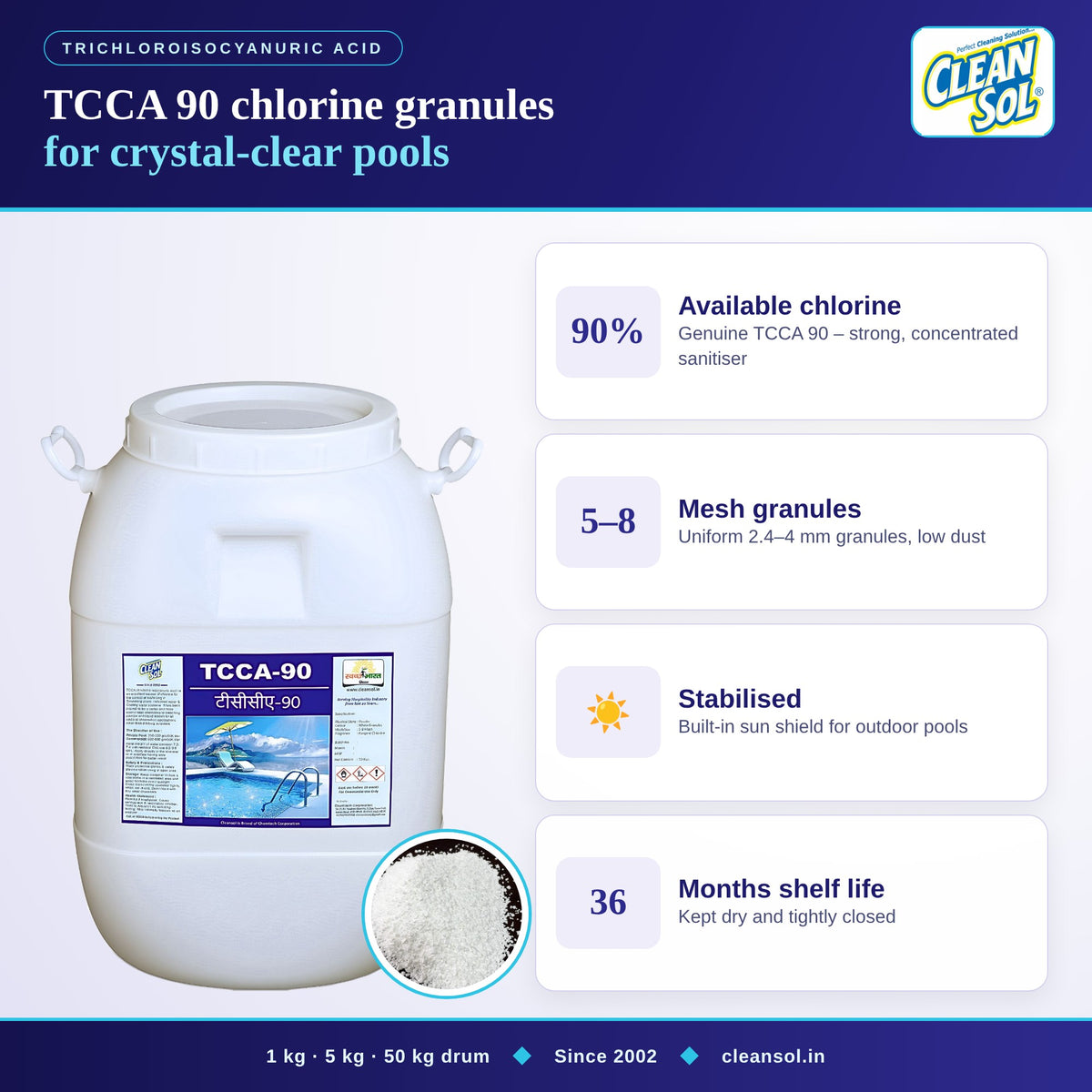
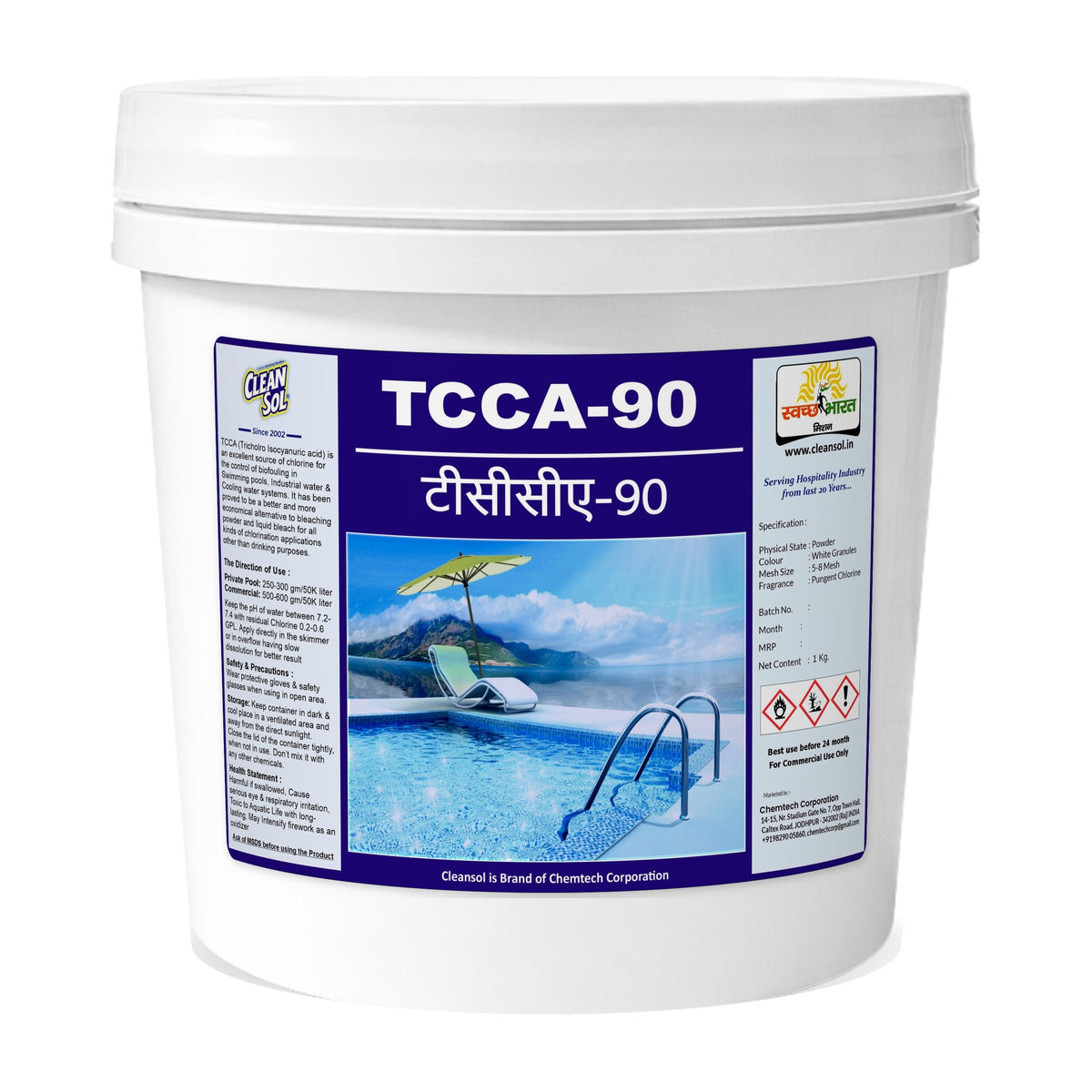
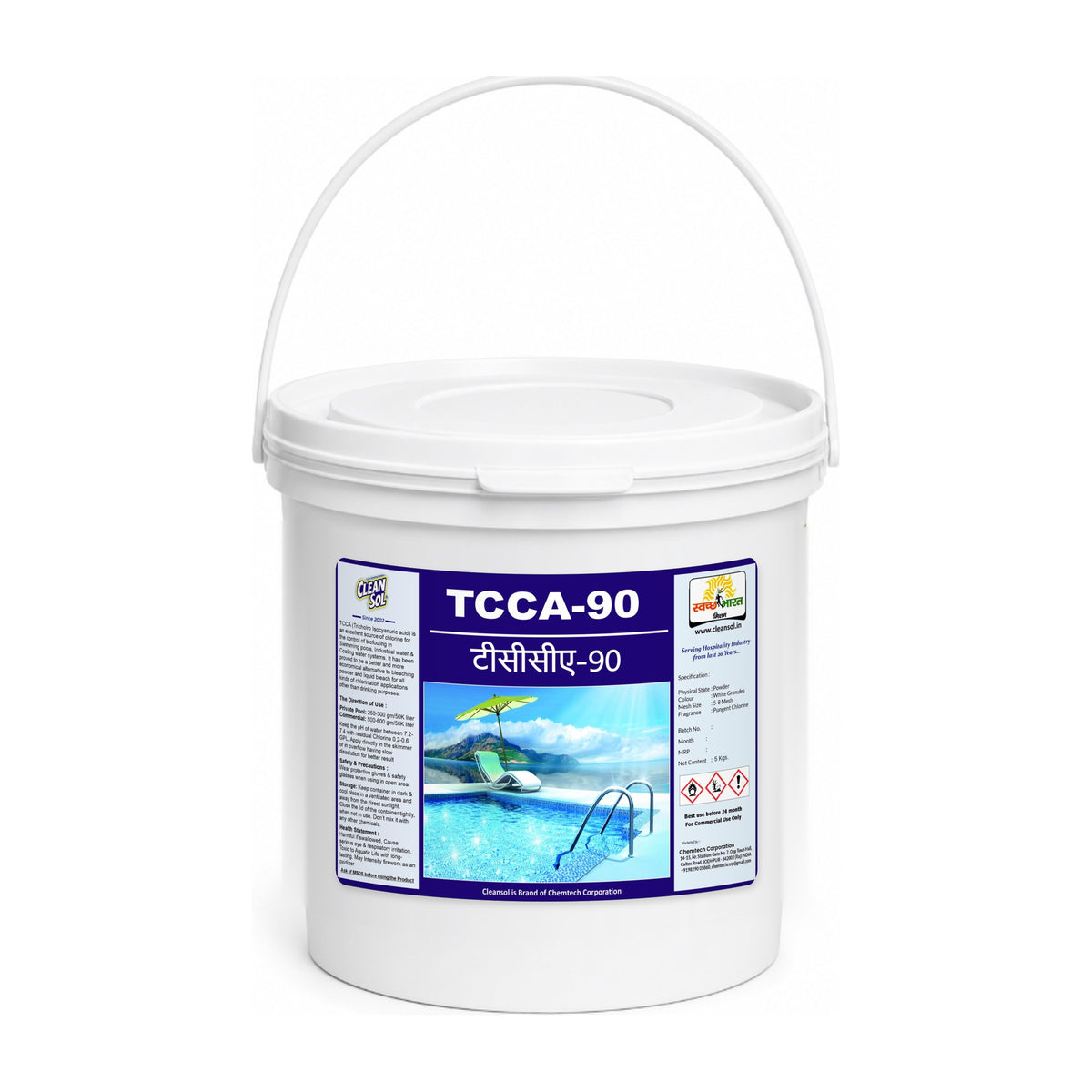
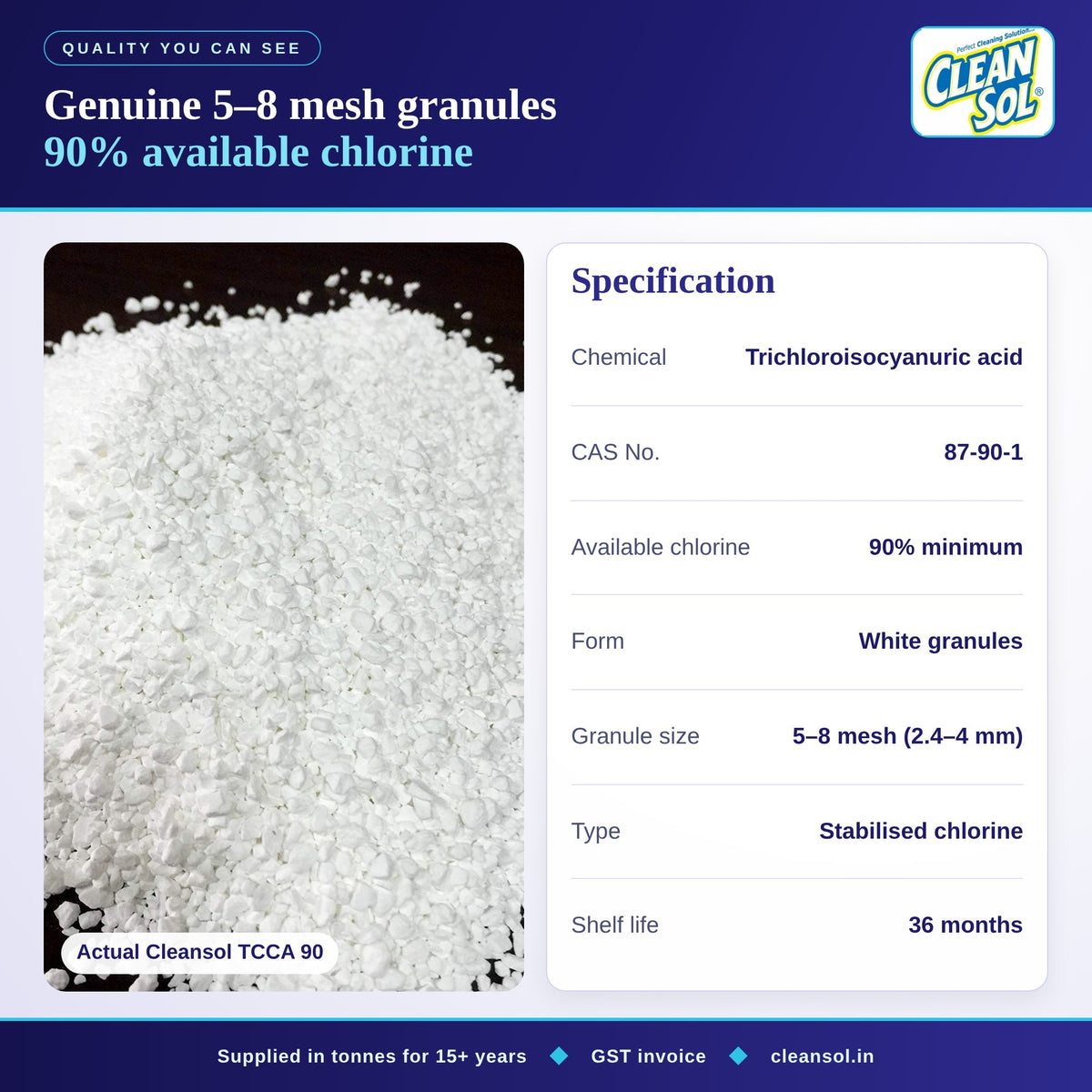
Cleansol TCCA 90 is genuine trichloroisocyanuric acid granules (5–8 mesh) with 90% available chlorine – the stabilised chlorine trusted by pool operators across India. Each granule carries its own sun-shield (cyanuric acid), so the chlorine lasts longer in outdoor pools under strong Indian sun. It keeps pool water clear and sanitised against bacteria and algae, and is also used for water tank disinfection, cooling towers, ETPs and surface sanitising. Packs: 1 kg, 5 kg and 50 kg drum. Made by Cleansol in Jodhpur since 2002 – supplied in tonnes to pools, hotels and industries for over 15 years.
90% available chlorine · Genuine 5–8 mesh granules · Stabilised for outdoor pools · 36-month shelf life
Typical daily dose: 2–3 g per 1,000 litres – about ₹1.2 per 1,000 L per day from the 5 kg pack
At a glance
| Chemical | Trichloroisocyanuric acid (TCCA), CAS 87-90-1 |
| Available chlorine | 90% minimum |
| Form | White granules, 5–8 mesh (about 2.4–4 mm), chlorine smell |
| Type | Stabilised chlorine – adds cyanuric acid (stabiliser) that protects chlorine from sunlight |
| Daily pool dose | 2–3 g per 1,000 litres (1 m³) – adjust by test |
| Target in pool | Free chlorine 2–3 ppm · pH 7.2–7.6 |
| Used for | Swimming pools, water tank disinfection, cooling towers, ETP / STP, surface and drain sanitising |
| Packs | 1 kg · 5 kg · 50 kg drum |
| Shelf life | 36 months from date of manufacture, stored dry and closed |
How TCCA keeps your pool safe
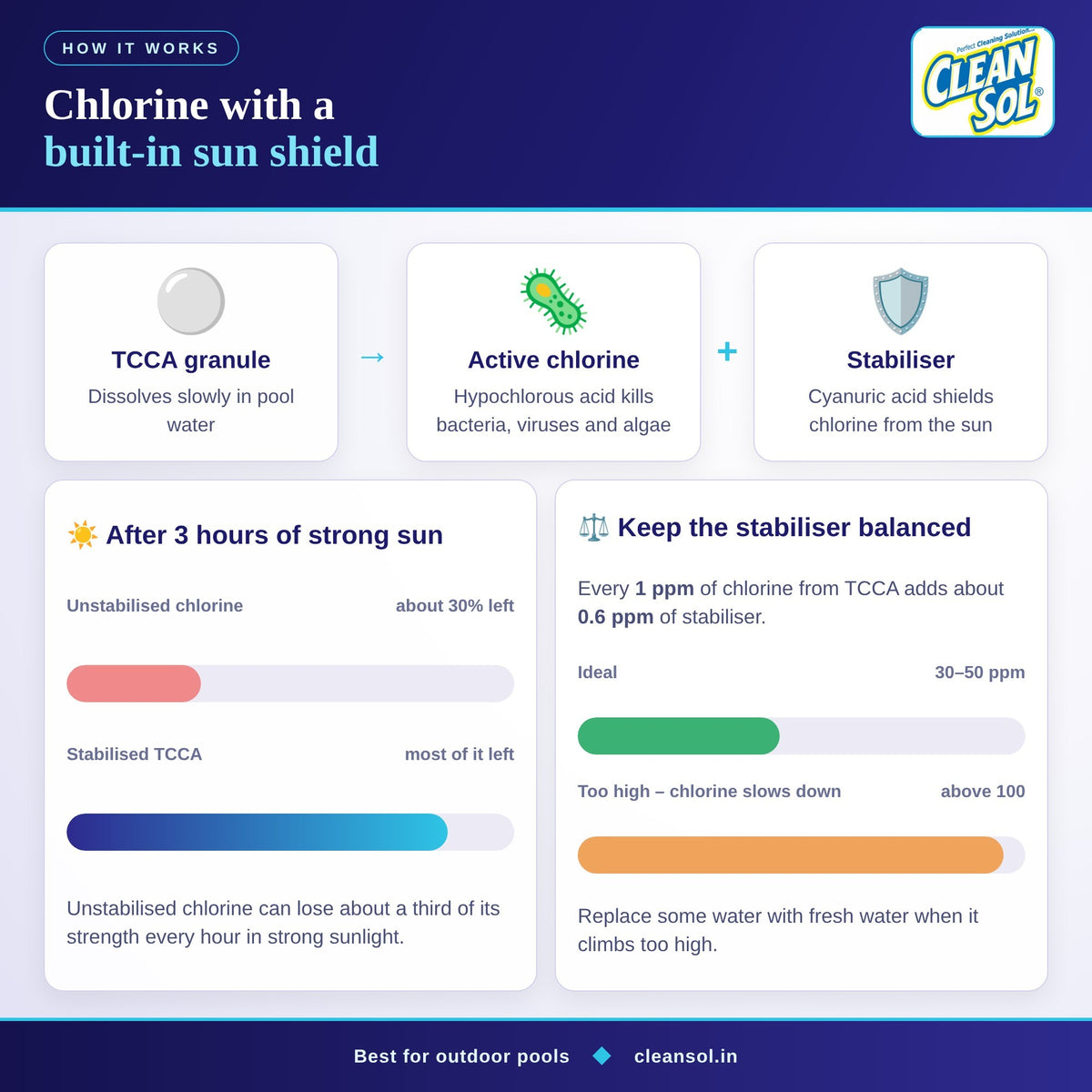
In water, TCCA releases hypochlorous acid – the active form of chlorine that kills bacteria, viruses and algae – plus cyanuric acid, which acts like sunscreen for chlorine. In strong sunlight, unstabilised chlorine can lose about a third of its strength every hour; stabilised chlorine lasts much longer. That is why TCCA is the first choice for outdoor pools in India.
For every 1 ppm of chlorine TCCA adds, it also adds about 0.6 ppm of stabiliser. A little stabiliser is good (30–50 ppm); too much slows the chlorine down. The routine below keeps it in balance.
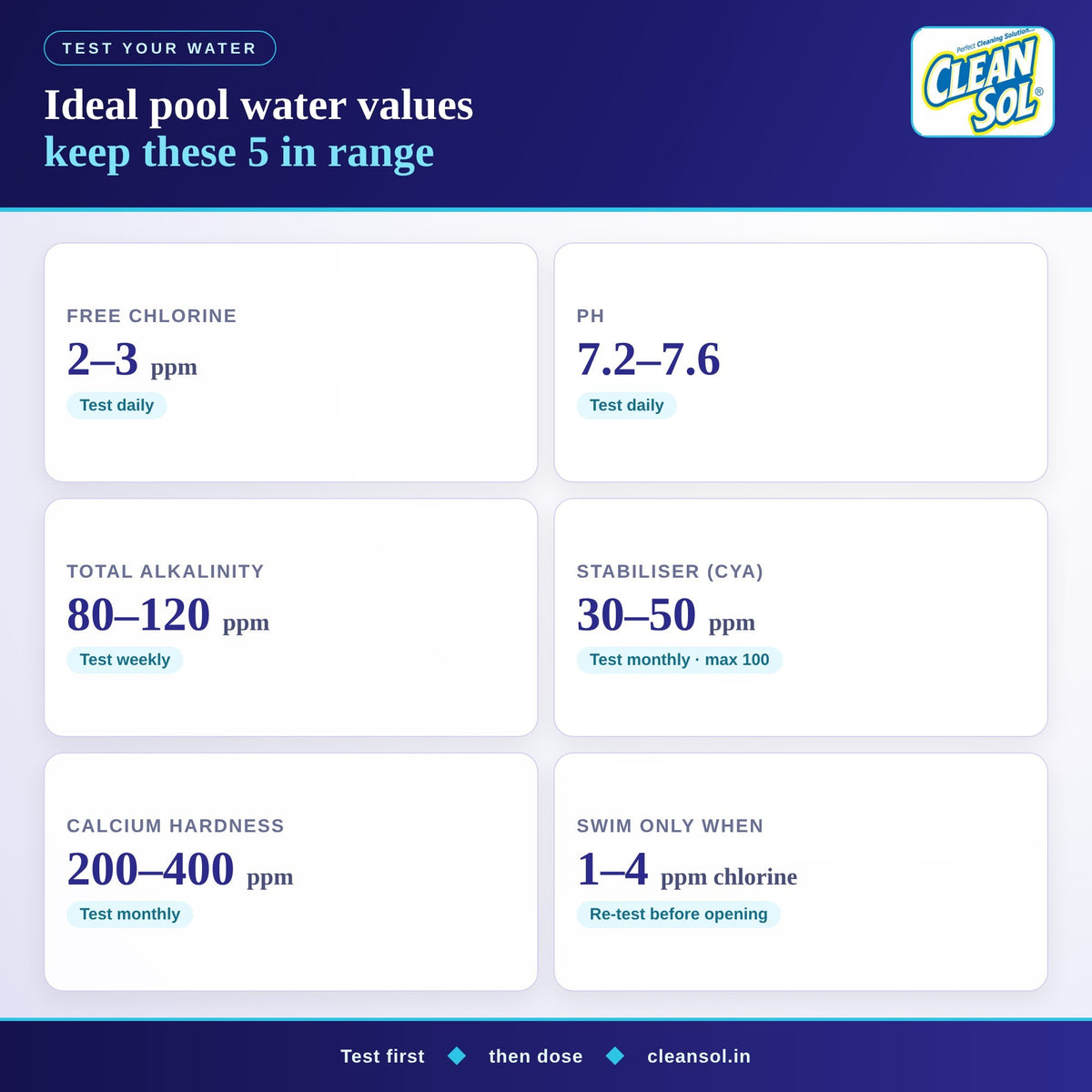
Ideal pool water values
| Test | Keep it at | Test how often |
| Free chlorine | 2–3 ppm (swim between 1 and 4 ppm) | Daily, before opening |
| pH | 7.2–7.6 | Daily |
| Total alkalinity | 80–120 ppm | Weekly |
| Stabiliser (cyanuric acid) | 30–50 ppm (not above 100) | Monthly |
| Calcium hardness | 200–400 ppm | Monthly |
How much TCCA does my pool need?
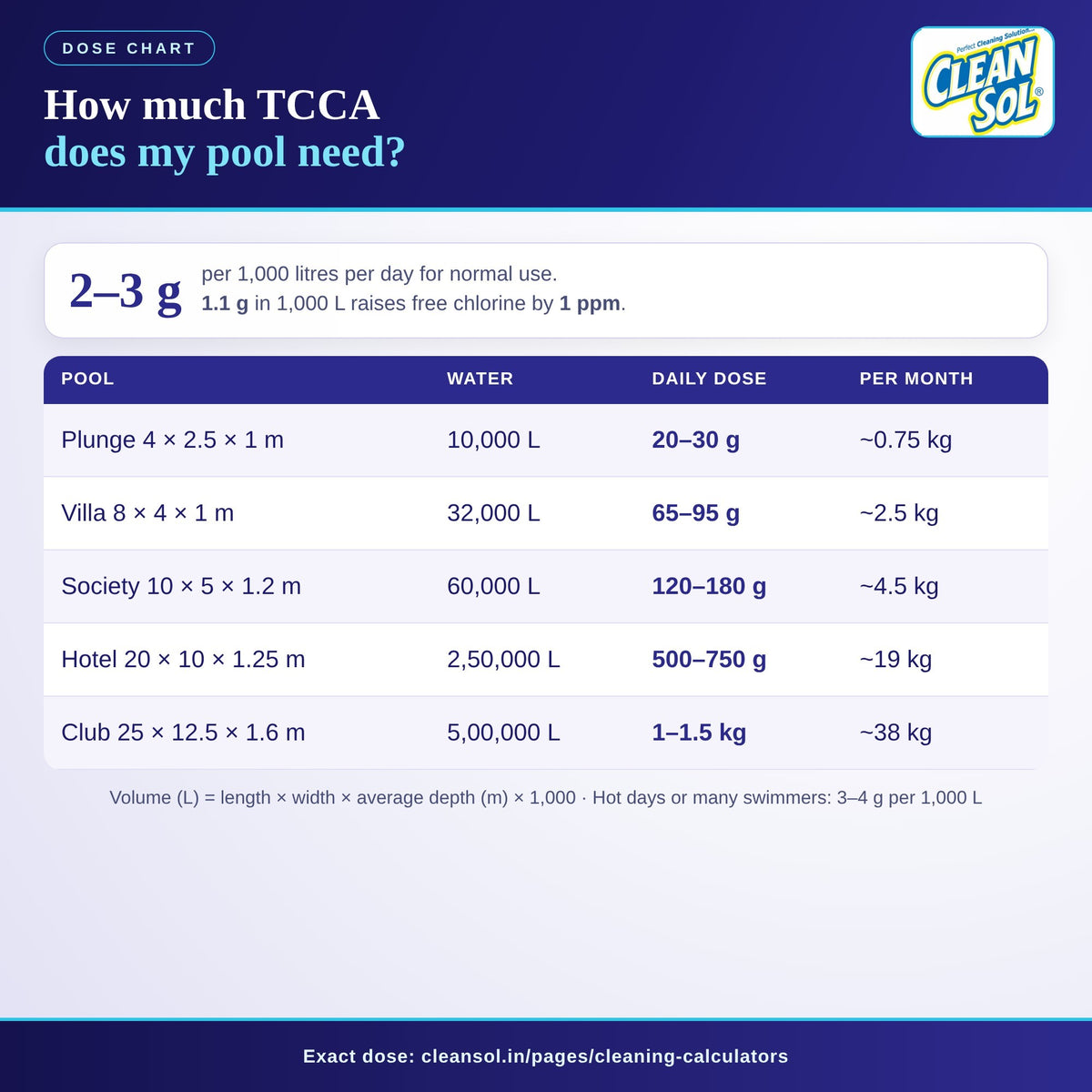
The basic rule: 1.1 g of TCCA 90 in 1,000 litres raises free chlorine by 1 ppm. Pool volume in litres = length × width × average depth (in metres) × 1,000.
| Pool (approx.) | Water | Daily dose | Per month |
| Plunge pool 4 × 2.5 × 1 m | 10,000 L | 20–30 g | about 0.75 kg |
| Villa pool 8 × 4 × 1 m | 32,000 L | 65–95 g | about 2.5 kg |
| Society pool 10 × 5 × 1.2 m | 60,000 L | 120–180 g | about 4.5 kg |
| Hotel pool 20 × 10 × 1.25 m | 2,50,000 L | 500–750 g | about 19 kg |
| Club pool 25 × 12.5 × 1.6 m | 5,00,000 L | 1–1.5 kg | about 38 kg |
| Situation | Dose per 1,000 litres |
| New fill / after refilling | 3–4 g on day one (about 3 ppm), then the daily dose |
| Daily – normal use | 2–3 g |
| Hot summer, many swimmers, after a party | 3–4 g |
| Cloudy water, slime or early algae | Shock to 10 ppm – best with Sodium Hypochlorite 10–12% (about 100 ml per 1,000 L), which adds no stabiliser |
🧮 Work out your exact dose with our free Swimming Pool Chlorine Calculator – enter your pool size and test reading. These doses are a starting point: your daily test reading decides the final dose.
Pool still green after adding chlorine?
Find the real cause – high pH, too much stabiliser, filter or metals – with a day-by-day rescue plan, plus fixes for cloudy water, strong chlorine smell and bugs on the walls.
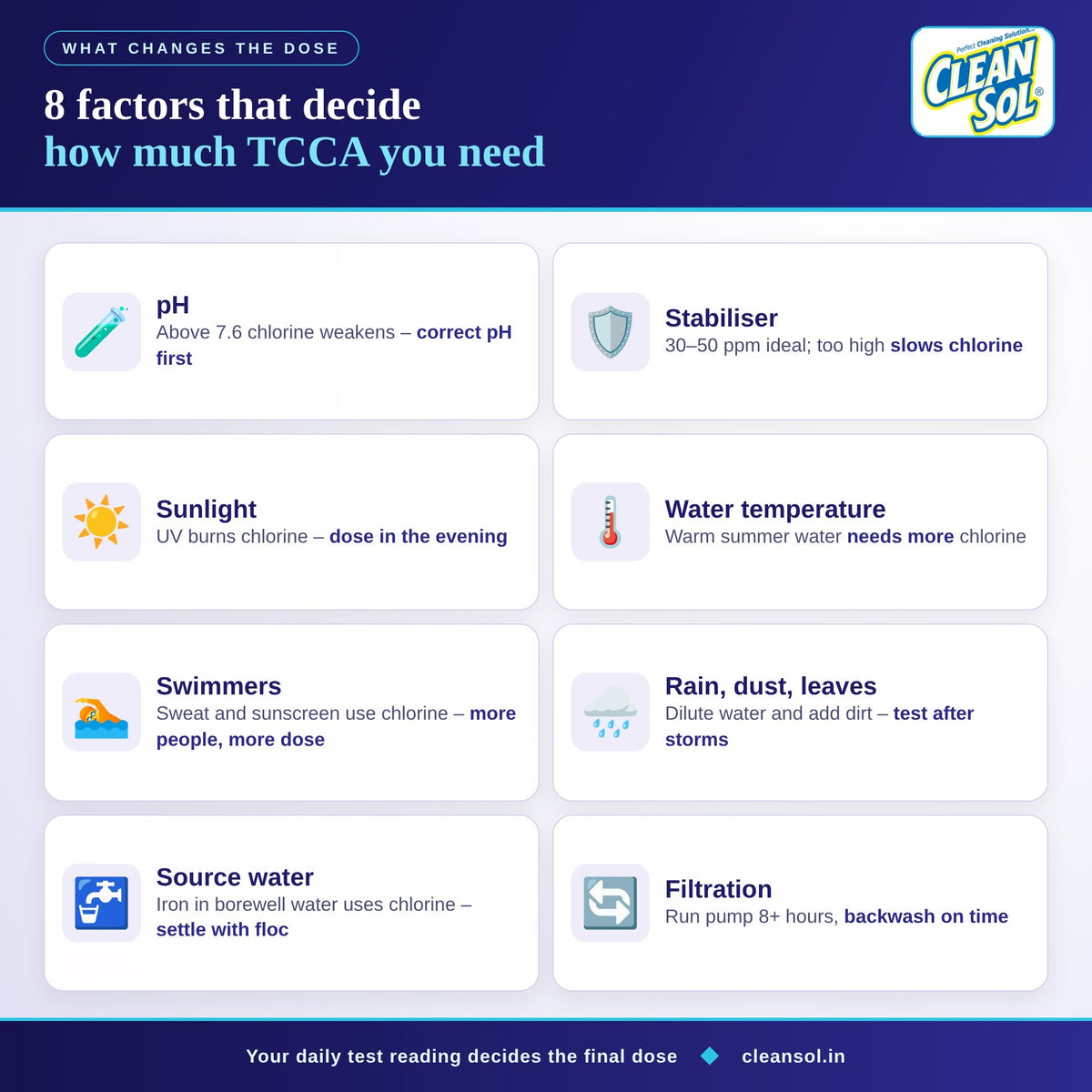
What changes the dose – 8 factors explained
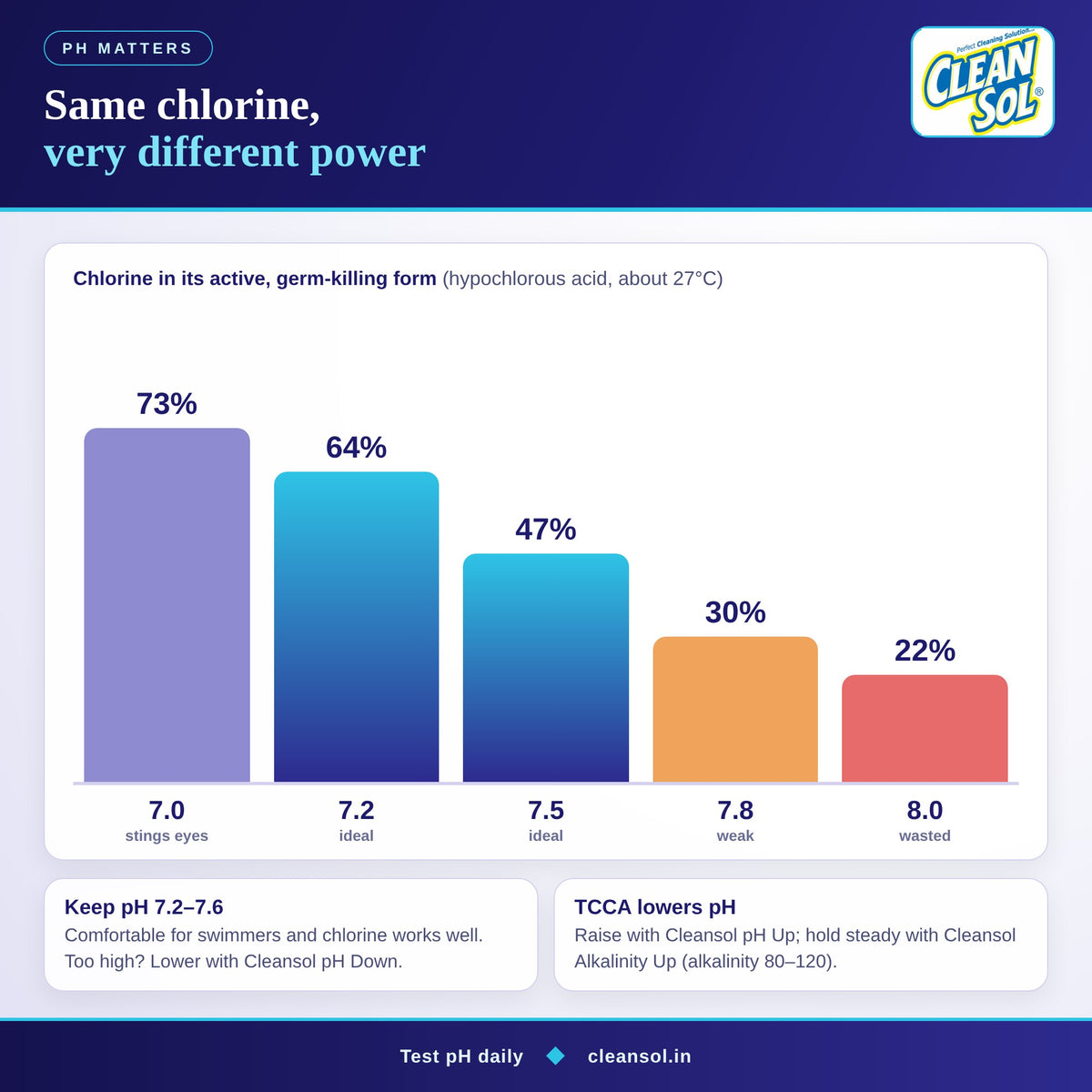
1. pH – the biggest factor in how hard chlorine works. The same chlorine is much weaker at high pH:
| pH | Chlorine in its active, germ-killing form* | What it means |
| 7.0 | about 73% | Strong, but water may sting eyes and corrode fittings |
| 7.2–7.6 | about 64–41% | Best balance – comfortable and effective |
| 7.8 | about 30% | Chlorine slows down, cloudy water and scale start |
| 8.0 | about 22% | You pay for chlorine that barely works |
*Hypochlorous acid share of free chlorine at about 27°C, in water without stabiliser. Stabiliser softens the effect of pH, but 7.2–7.6 is still the right range for comfort and clear water.
TCCA is acidic, so it slowly lowers pH and alkalinity. Check pH daily. If it falls below 7.2, raise it with Cleansol pH Up (start with 5 g per 1,000 L, dissolved, and re-test after 4–6 hours). If alkalinity falls below 80 ppm, add Cleansol Alkalinity Up – about 17 g per 1,000 L raises alkalinity by 10 ppm.
2. Stabiliser (cyanuric acid). At 30–50 ppm it protects chlorine from the sun. Above that, the chlorine works more slowly, so keep free chlorine at least 2–3 ppm. Daily TCCA use raises stabiliser by roughly 1 ppm a day – it only leaves the pool with backwash, splash-out and fresh water. If it goes above 80–100 ppm, replace part of the water with fresh water, and use Sodium Hypochlorite instead of TCCA for a few weeks.
3. Sunlight. UV breaks chlorine down. Stabilised TCCA is protected, but still dose in the evening or after closing, so chlorine works overnight without sun loss.
4. Water temperature. Warm water (30°C and above in Indian summers) uses chlorine faster and grows algae faster. Expect to dose at the higher end of the range in April–June.
5. Swimmers. Sweat, body oils, sunscreen and urine use up chlorine and form chloramines – the cause of the "chlorine smell" and red eyes. More swimmers means a bigger dose. A quick shower before swimming cuts chlorine use noticeably.
6. Rain, dust and leaves. Rain dilutes the water and lowers pH; dust storms and leaves bring organic dirt. Test and top up chlorine after every heavy rain or dust storm.
7. Source water. Borewell or tanker water can contain iron and manganese, which turn the water brown or green when chlorinated and use up chlorine. After the first chlorine dose, settle the brown particles with Pool Floc Powder, vacuum them out to waste, then bring chlorine back to 2–3 ppm. Very hard water (calcium above 400 ppm) leaves scale on tiles.
8. Filtration and circulation. Chlorine only works where water moves. Run the pump at least 8 hours a day, backwash the filter when the pressure rises, and brush walls and corners weekly with a Pool Algae Brush.
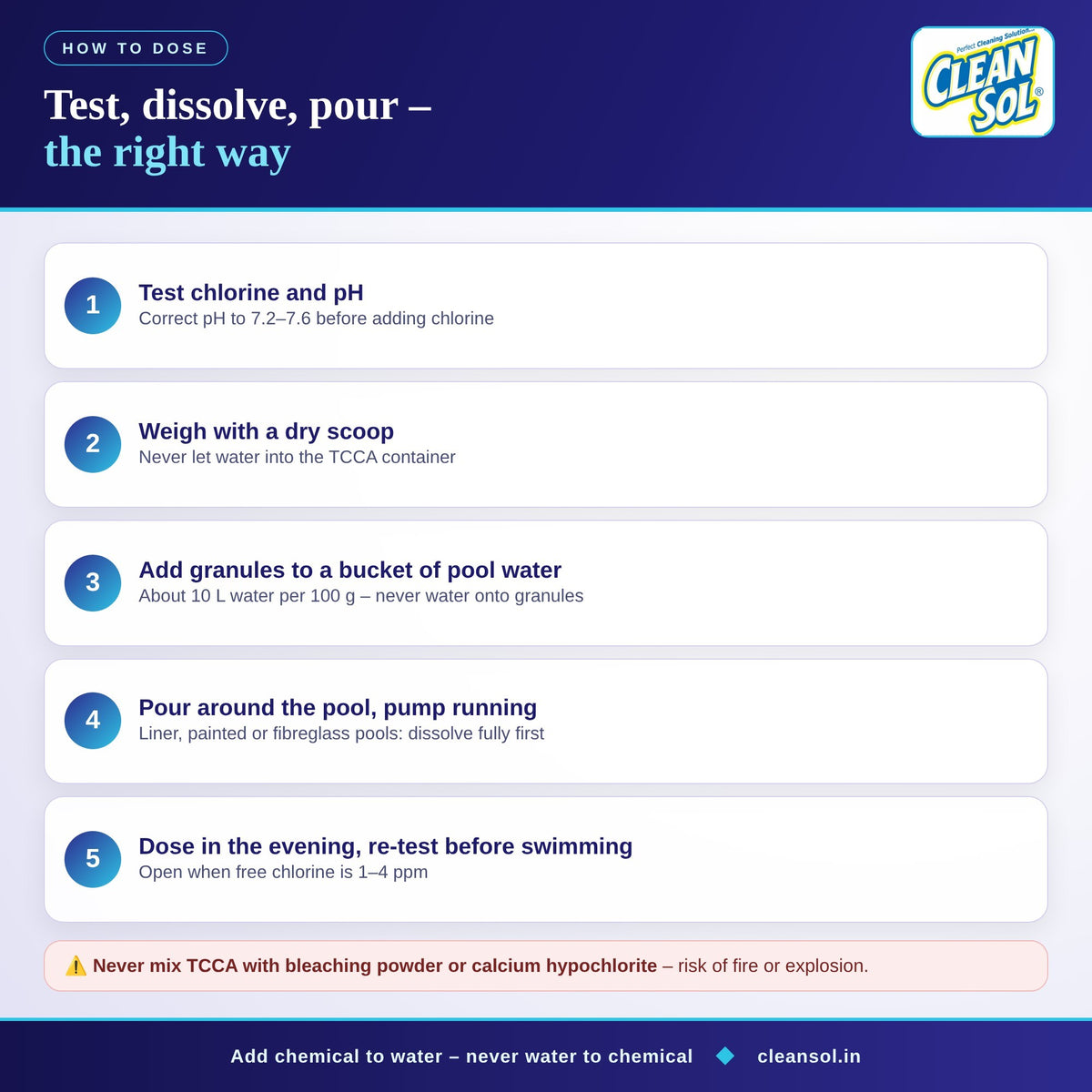
How to dose TCCA
- Test first. Check free chlorine and pH with a Pool pH & Chlorine Test Kit. Correct pH to 7.2–7.6 before adding chlorine.
- Weigh the dose with a clean, dry plastic scoop. Never let water or other chemicals into the TCCA container.
- Pre-dissolve: fill a clean plastic bucket with pool water, then add the granules to the water (never water onto granules). Stir with a plastic stick. TCCA dissolves slowly – use about 10 litres of water for every 100 g.
- Pour slowly around the pool or in front of the return inlets, with the pump running. In tiled pools, any undissolved granules can be spread over the deep end and brushed – in liner, painted or fibreglass pools always pre-dissolve fully, as settled granules can bleach the surface.
- Dose in the evening and keep the pump running for at least 4–6 hours. Re-test before swimmers enter – open only when free chlorine is between 1 and 4 ppm.
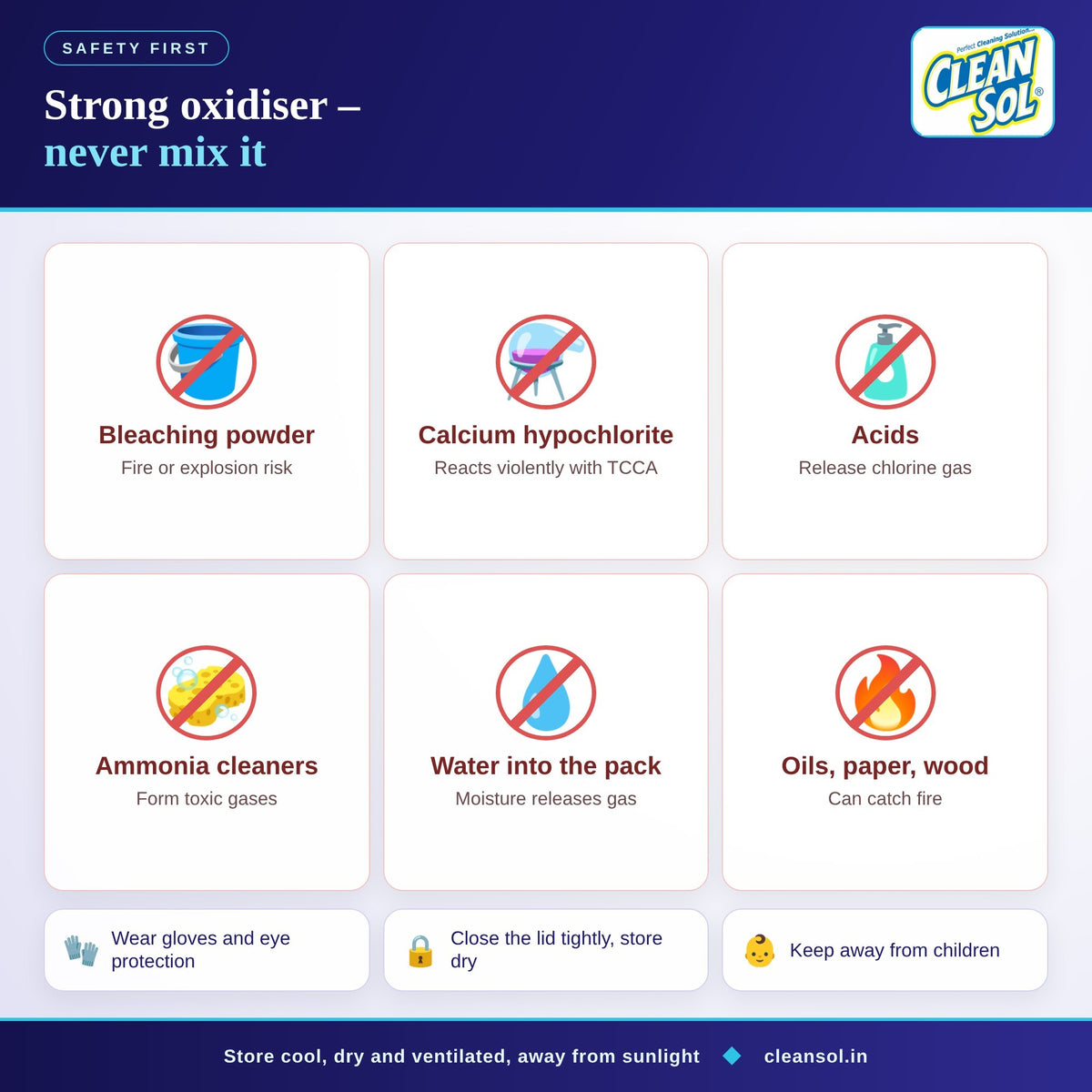
⚠️ Never mix TCCA with bleaching powder or calcium hypochlorite – even small amounts together can cause fire or an explosion. Never add TCCA to a skimmer or feeder that has held another chlorine product. Never mix it with acids, ammonia, sodium hypochlorite or any other chemical in a container.
Weekly pool routine
- Daily: test chlorine and pH, dose TCCA in the evening, skim leaves with a Leaf Net.
- Twice a week: brush walls, steps and corners; vacuum the floor.
- Weekly: check alkalinity, backwash the filter, add Copper Sulphate Algaecide if your pool is prone to algae.
- Monthly: check stabiliser and hardness; replace 10–15% of the water if stabiliser is climbing.
TCCA or other chlorine?
| Product | Chlorine | Best for |
| TCCA 90 granules | 90%, stabilised | Daily chlorine for outdoor pools – least product to store and handle |
| Sodium Hypochlorite 10–12% | 10–12%, liquid, no stabiliser | Shock treatment, indoor pools, and when stabiliser is high |
| Bleaching Powder | About 30%, leaves lime | Drains, tanks and general disinfection – store far away from TCCA |
TCCA is meant for outdoor pools. For indoor pools and spas, which get no sunlight, use unstabilised chlorine such as sodium hypochlorite.
Beyond the pool
| Use | How |
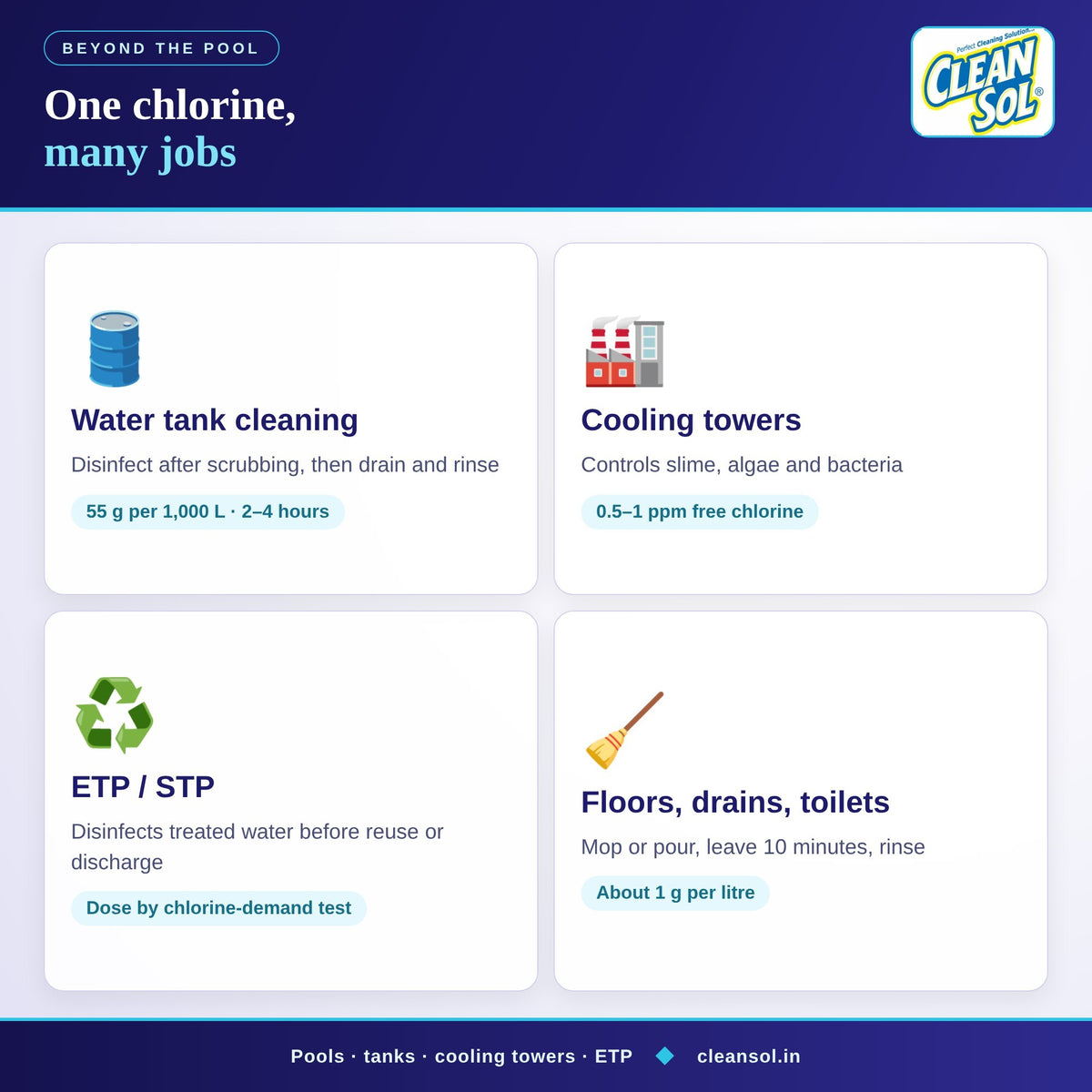
| Water tank cleaning | After emptying and scrubbing the tank, fill partly and disinfect with about 55 g per 1,000 L (50 ppm) for 2–4 hours. Then drain, rinse and refill. For routine chlorination of stored water, use Chlorine Tablets for Water Tank. |
| Cooling towers | Controls slime, algae and bacteria in the basin and fill. Dose as advised by your water-treatment engineer, usually to keep 0.5–1 ppm free chlorine. |
| ETP / STP | Disinfection of treated water before reuse or discharge – dose by a chlorine-demand test. |
| Floors, drains and toilets | Dissolve about 1 g in 1 litre of water, mop or pour, leave 10 minutes, rinse. Not for metal, fabric or coloured surfaces. |
Which pack is right for you?
| Pack | Best for | Delivery |
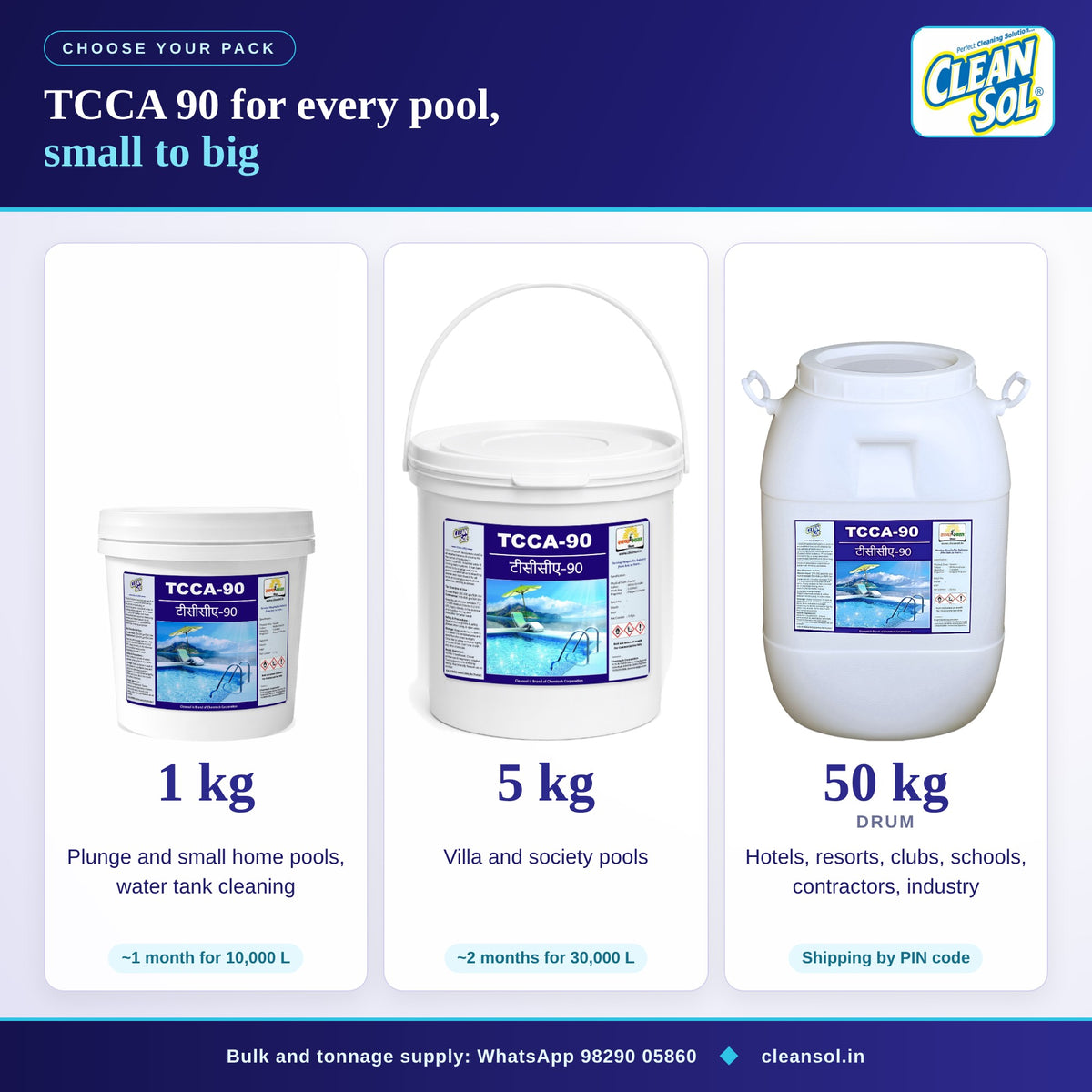
| 1 kg | Plunge and small home pools, water tank cleaning – lasts about a month for 10,000 L | Free delivery |
| 5 kg | Villa and society pools – about 2 months for a 30,000 L pool | Free delivery |
| 50 kg drum | Hotels, resorts, clubs, schools, pool contractors and industries | Shipping charged by PIN code |
Everything for crystal-clear water
Test with the pH & Chlorine Test Kit, sanitise with TCCA 90, prevent algae with Copper Sulphate Algaecide, clear cloudy water with Pool Floc Powder, and shock with Sodium Hypochlorite.
TCCA 90 supplier in Jodhpur, Rajasthan – delivering across India
Cleansol (Chemtech Corporation) has been a TCCA 90 supplier in Jodhpur since 2002, supplying chlorine granules in tonnes to hotels, resorts, clubs, schools, housing societies, pool contractors and water-treatment plants. Orders are dispatched from Jodhpur within 24 working hours and delivered across Rajasthan – Jaipur, Udaipur, Jaisalmer, Bikaner, Ajmer and more – and all over India in 3–6 days. For 50 kg drums and regular tonnage supply, WhatsApp 98290 05860 for a bulk price.
Why choose Cleansol
- Genuine TCCA 90: 90% minimum available chlorine – no fillers, no low-grade blends.
- True 5–8 mesh granules: uniform size, low dust, easy to weigh and dissolve.
- Trusted in bulk: supplied in tonnes to pools, hotels and industries for over 15 years.
- Long shelf life: 36 months when stored dry and closed.
- Honest guidance: clear doses and water-balance advice, plus WhatsApp support from our team.
- GST invoice on every order.
Safety & storage
- Strong oxidiser. Keep away from bleaching powder, calcium hypochlorite, acids, ammonia, oils, paper, wood and anything flammable.
- Keep it dry. A little water or moisture inside the pack can release chlorine gas. Always close the lid tightly and use a dry scoop.
- Wear gloves and eye protection; do not breathe the dust. If it gets in the eyes, rinse with plenty of water for 15 minutes and see a doctor.
- Always add TCCA to water – never water to TCCA. Never mix it with other chemicals.
- Store in the original container, in a cool, dry, ventilated place, away from sunlight and out of reach of children.
- Do not reuse the empty container for other chemicals.
Frequently asked questions
How much TCCA should I add to my pool daily?
About 2–3 g per 1,000 litres a day for normal use, up to 3–4 g on hot days or with many swimmers. A 50,000 L pool needs about 100–150 g a day. Always test first – the aim is 2–3 ppm free chlorine.
How do I calculate my pool volume?
Length × width × average depth in metres × 1,000 = litres. For example, 10 m × 5 m × 1.2 m = 60,000 litres. Or use our Pool Chlorine Calculator.
Why does my pool smell strongly of chlorine?
A strong smell and red eyes usually mean too little free chlorine, not too much – the smell comes from chloramines formed by sweat and urine. Shock the pool to 10 ppm with Sodium Hypochlorite, keep the pump running and re-test before swimming.
I add TCCA daily but the water is still green or cloudy. Why?
Check in this order: pH above 7.6 (chlorine weakens – lower it with Cleansol pH Down), stabiliser above 80–100 ppm (chlorine slows down), poor filtration or a dirty filter, or iron in the source water. Correct pH, backwash the filter, brush the walls, shock with sodium hypochlorite, then use Pool Floc to settle fine dirt.
Why does my pH keep dropping?
TCCA is acidic, so pH and alkalinity drift down with regular use. Keep alkalinity at 80–120 ppm with Cleansol Alkalinity Up – it holds pH steady – and raise pH with Cleansol pH Up when it falls below 7.2.
Can I swim right after adding TCCA?
Wait until the granules have fully dissolved and mixed – at least 4–6 hours with the pump running, ideally overnight. Swim only when free chlorine is between 1 and 4 ppm.
Can I put TCCA granules directly into the pool?
Pre-dissolving in a bucket of pool water is best. In tiled pools, small amounts can be spread over the deep end with the pump running and brushed. Never put granules straight into liner, painted or fibreglass pools – they can bleach the surface.
Can I use TCCA with bleaching powder?
No – never mix them, never put them in the same bucket, scoop or feeder, and store them apart. Bleaching powder and calcium hypochlorite react dangerously with TCCA.
Is TCCA good for indoor pools?
No – indoor pools get no sunlight, so the stabiliser only builds up without any benefit. Use Sodium Hypochlorite for indoor pools and spas.
What does "5–8 mesh" mean?
It is the granule size – about 2.4 to 4 mm. Uniform granules flow and weigh easily, make little dust and dissolve at a steady rate.
How long does TCCA last in storage?
36 months from manufacture, if kept dry, tightly closed and out of sunlight.
Do you supply hotels, contractors and industries?
Yes – 50 kg drums and regular tonnage supply with GST invoice. WhatsApp 98290 05860 for bulk prices.
TCCA 90 (trichloroisocyanuric acid) granules, 5–8 mesh, 90% available chlorine – stabilised chlorine for swimming pools, water tank disinfection, cooling towers and ETPs. Dosing information is general guidance; follow your test readings and local regulations. For bulk queries, email info@cleansol.in.
Prefer road transport? For orders of 25 kg and above, tick Send by road transport (to-pay) in the cart and add your transporter’s name and number. You pay the freight to the transporter on delivery.
Dispatched in 1–2 working days from Jodhpur. Delivery across India.
In stock
GST invoice with every order
- Ships from
- Cleansol, Jodhpur
- Sold by
- Cleansol (packed & marketed)
- Invoice
- GST invoice provided
Buying in bulk?
Get factory price for 25 kg+
Drums, bags and regular monthly supply at better rates, with GST invoice and pan-India dispatch.
Select pack size * (tap one)
Please select a pack size and fill all fields marked * (PIN code must be 6 digits).
- 1Share product & quantity
- 2Get factory quote with GST, same working day
- 3Dispatched from Jodhpur with tracking
Specifications
| Chemical name | 1,3,5-Trichloro-1,3,5-triazinane-2,4,6-trione / trichloroisocyanuric acid (C3Cl3N3O3) |
|---|---|
| Also known as | TCCA 90, Symclosene, Chlorine granules |
| Grade | Industrial |
| Purity / strength | 90% min available chlorine |
| CAS number | 87-90-1 |
| HSN code | 293369 |
| Packing | 1 kg, 5 kg, 50 kg |
Typical values for reference only, not a guaranteed specification. Exact values vary by batch and manufacturer.
Applications & industries
- Swimming pools
- Water tank disinfection
- Cooling towers
- Etp / stp
- Floor and drain sanitising
Industries: Water treatment
Storage & handling
Keep tightly closed; moisture releases chlorine and NCl3
Never store with calcium hypochlorite/bleaching powder, acids, ammonia or organics
Use dry, clean scoops only
Safety & first aid
PPE: Chemical goggles, rubber gloves, dust mask/respirator, protective clothing.
First aid: Eyes – rinse immediately with water for at least 15 min, get medical help; Skin – remove contaminated clothing, wash with plenty of water; Inhalation – move to fresh air; Ingestion – rinse mouth, do not induce vomiting, get immediate medical help
Spills: Collect dry with clean tools into a dry plastic container; never add water to bulk spill or mix with sweepings; flush small residues with large amounts of water.
Do not mix with: Calcium hypochlorite/bleaching powder (fire/explosion risk), acids, ammonia and urea (explosive NCl3), organics, oils, reducing agents.
Technical support & disclaimer
For usage, dosage, or formulation guidance, email info@cleansol.in or WhatsApp +91 98290 05860.
Specifications are typical values for reference only. Users must verify suitability and comply with applicable regulations before use. This product is intended for professional and commercial use; the buyer is responsible for safe handling, storage and disposal. Cleansol assumes no liability for misuse.