Cleansol Guide · Pool Care
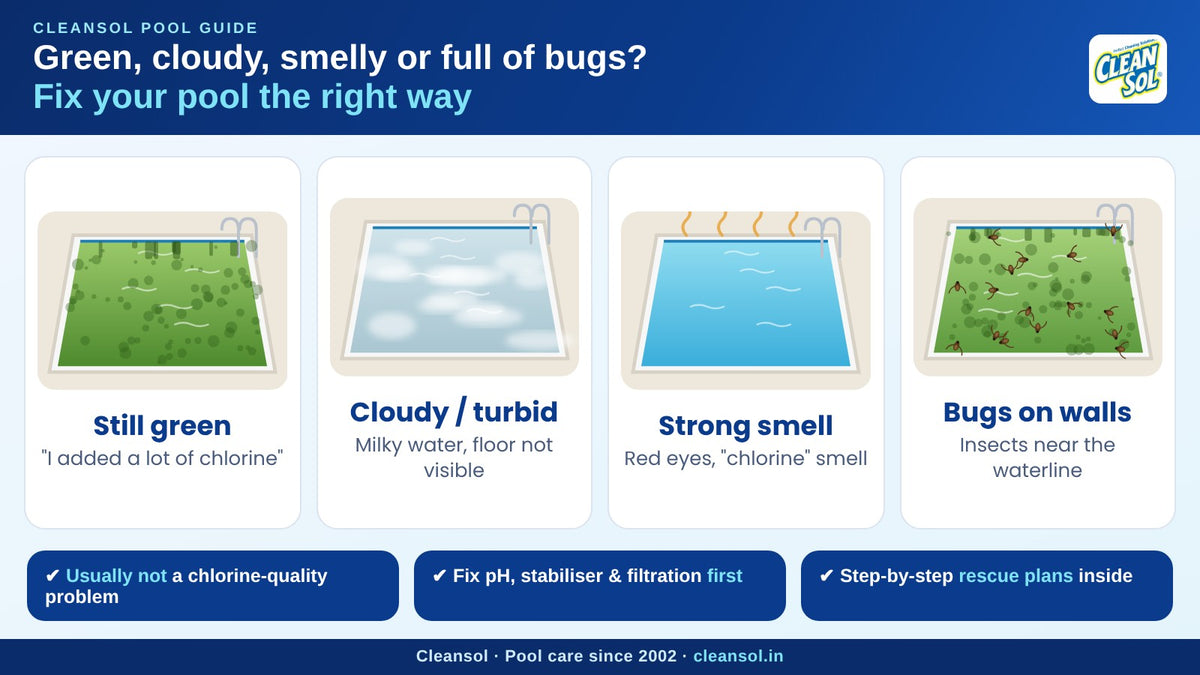
Pool still green after adding chlorine? How to fix green, cloudy and smelly water – and bugs on the walls
"I added a lot of chlorine, but my pool is still green – your TCCA is not working." After supplying TCCA 90 to pools across India for over 15 years, this is the question we hear most. The honest answer: in almost every case the chlorine is working – but something in the water is stopping it, or the dose is far too small for the algae already growing. This guide shows how to find the real cause and fix it, step by step.
pH 7.2–7.6
check this first
2–3 ppm
free chlorine daily
8+ hours
pump run every day
3–5 days
to rescue a green pool

Quick answer: If your pool stays green after chlorine, first correct the pH to 7.2–7.6, run the pump 24 hours and brush every wall. Then shock with liquid sodium hypochlorite (about 100 ml of 10–12% per 1,000 litres for light green, 150–200 ml for dark green) and keep that level up for 3–5 days until the water is clear. If you have used TCCA for many months without draining, replace 30–50% of the water first – too much stabiliser is the number-one reason a shock fails.
In this guide
Problem 1: "I added a lot of chlorine – my pool is still green"

Green water means algae is growing faster than the chlorine can kill it. Algae can double in a day in warm Indian summers, so a pool can turn from clear to green over one hot weekend. These are the 8 reasons we find most often when a customer says the chlorine "isn't working":
| Reason | What is happening | What to do |
| 1. pH above 7.8 | At pH 8.0 only about a fifth of the chlorine is in its active, germ-killing form – at pH 7.2 it is about two-thirds. Borewell water and new plaster often push pH up – bring it down with Cleansol pH Down. | Bring pH to 7.2–7.6 before adding chlorine. Test daily. |
| 2. Too much stabiliser | TCCA adds stabiliser (cyanuric acid) every day. After months without fresh water it can go above 80–100 ppm and slow chlorine right down – often called "chlorine lock". | Replace 30–50% of the water, then shock with sodium hypochlorite (it adds no stabiliser). |
| 3. Dose far too small | A daily dose of 2–3 ppm keeps a clean pool clean. It cannot kill algae that is already growing – that needs a shock of 10–20 ppm, held for several days. | Follow the rescue plan below. |
| 4. Pump runs only 2–3 hours | Chlorine only works where water moves. Corners, steps and behind ladders become "dead spots" where algae starts. | Run the pump at least 8 hours daily, 24 hours during a rescue. |
| 5. Dirty or old filter sand | Sand that is caked, channelled or older than 5–7 years lets fine algae pass straight back into the pool. | Backwash when pressure rises; replace old sand with fresh filter media. |
| 6. No brushing | Algae forms a slimy film on walls, steps and grout lines that protects it from chlorine. | Brush every surface with a Pool Algae Brush – daily during a rescue. |
| 7. Metals in the water | Iron or manganese in borewell or tanker water – or an overdose of copper algaecide – can turn water green, brown or teal when chlorine is added. The water is often clear but coloured, and walls feel smooth, not slimy. | This is not algae: settle with Pool Floc and vacuum to waste. Use only the stated algaecide dose. |
| 8. Test kit gives a false reading | Yellow OTO kits read only up to about 3–5 ppm. At very high chlorine the colour bleaches out and can look like zero – so people keep adding more. | Use the dilution trick in the next section; replace reagents older than a year. |
Algae or metals – a quick check: rub a wall with your hand. Slimy and slippery = algae. Smooth wall, clear but coloured water that got worse right after adding chlorine = metals.
Before you blame the chlorine: two simple checks

A. The 1-hour chlorine test. Test free chlorine and pH and note the readings. Add TCCA for +2 ppm – that is 2.2 g per 1,000 litres, dissolved in a bucket of pool water and poured in with the pump running. Test again after one hour.
- Chlorine went up by about 2 ppm? The chlorine is fine. Your pool is simply using it up – algae, dirt, high pH or too few pump hours. Go to the rescue plan.
- It did not rise at all? The pool has a very heavy chlorine demand – thick algae, leaves, or ammonia from sweat and urine. You need a proper shock with liquid chlorine, not more daily TCCA.
B. Is your test kit telling the truth? If the sample turns pale instead of yellow, the chlorine may be too high to read. Mix 1 part pool water with 4 parts RO or bottled water (not tap water, which contains chlorine), test it, and multiply the reading by 5.
The free Pool Chlorine Calculator turns your pool size and reading into an exact dose.
Green pool rescue plan – shock, brush, filter

- Prepare. Scoop out leaves and debris with a Leaf Net. Make sure the pump and filter are working. Correct pH to 7.2–7.5. If the pool has been on TCCA for months without fresh water, drain and refill 30–50% first.
- Shock in the evening with Sodium Hypochlorite 10–12%: about 100 ml per 1,000 L (≈10 ppm) for light green, 150–200 ml per 1,000 L for dark green or black-bottom pools. Pour slowly in front of the return inlets with the pump running. Do not shock with TCCA – repeated TCCA shocks pile up stabiliser and make the problem worse.
- Brush everything – walls, floor, steps, corners, behind the ladder and inside the skimmer mouth. Brushing breaks the algae film so chlorine can reach it.
- Run the pump 24 hours a day until the pool is clear. Backwash when the filter pressure rises.
- Hold the shock level. Test 2–3 times a day and add more sodium hypochlorite to keep the level up. Green turns grey-blue, then cloudy, as the algae dies.
- Clear the dead algae. If the water stays milky after 2–3 days, use Pool Floc (see Problem 2) and vacuum the settled layer to waste.
- Stop when all 3 checks pass: the water is crystal clear, free chlorine drops by less than 1 ppm overnight, and there is no algae on any wall or step. Then correct pH again (sodium hypochlorite raises it) and go back to daily TCCA 90 at 2–3 g per 1,000 L.
⚠️ Never mix TCCA with bleaching powder or calcium hypochlorite – not in the pool feeder, bucket or store room. They can react violently and start a fire. Keep the pool closed to swimmers during a shock and until chlorine is back to 1–4 ppm.
Problem 2: cloudy, turbid water – you can't see the floor

Cloudy water is made of particles too small for the filter to catch. A cloudy pool is also a safety risk – lifeguards and parents can't see a swimmer on the floor of the deep end. The usual causes:
- Filtration: pump runs too few hours, filter overdue for backwash, or the sand is old and caked.
- High pH or hard water: calcium comes out of the water as a fine white haze – common with borewell water in Rajasthan, Gujarat and Delhi NCR, and after using bleaching powder.
- Dead algae right after a shock.
- Dust storms, rain and heavy swimmer use – sunscreen, sweat and dust.
- Low chlorine – the first sign of algae is often a dull, slightly cloudy pool.
The fix – in this order:
- Test and set pH 7.2–7.4 and free chlorine 2–3 ppm.
- Run the pump 24 hours and backwash the filter. Many cloudy pools clear in 1–2 days with just this.
- Still cloudy? Add Pool Floc Powder – about 40–50 g per 1,000 L, dissolved in a bucket of water and poured around the edge.
- Set the valve to Recirculate for 2 hours, then switch the pump off for 8–12 hours. Keep swimmers out so the floc can settle into a layer on the floor.
- Next morning, vacuum slowly with the valve on Waste – vacuuming floc into the filter just sends it back into the pool. Top up the water and rebalance.
- If the pool keeps going cloudy, open the filter: sand older than 5–7 years, or caked into lumps, should be replaced.
Problem 3: strong "chlorine" smell and red eyes

Most people think a strong chlorine smell means too much chlorine. It is usually the opposite. The smell, stinging eyes and coughing come from chloramines – chlorine that has already combined with sweat, urine, body oils and sunscreen. A well-run pool with enough free chlorine has very little smell.
- Measure it. Combined chlorine = total chlorine minus free chlorine (a DPD test kit shows both). Above 0.5 ppm, swimmers start to notice.
- Burn it out. Correct pH to 7.5 or lower, then raise free chlorine to about 10 times the combined chlorine with sodium hypochlorite. Run the pump overnight, keep the pool closed, and open doors and windows for indoor pools.
- Prevent it. Ask swimmers to shower before entering and take toilet breaks – this alone cuts chloramines noticeably. Keep 2–3 ppm free chlorine every day.
Rotten-egg or musty smell? That is usually stagnant water, or sulphur in borewell water. Shock, run the pump 24 hours and backwash.
Problem 4: lots of insects on the side walls

Small brown bugs gathering on the walls near the waterline are usually water boatmen. They feed on algae and lay eggs on it – so they are an early warning that algae is growing, even before you can see it. They are followed by backswimmers, which swim upside-down, hunt the water boatmen and can give a painful bite.
- Skim them out with a leaf net every morning.
- Brush and vacuum the walls, steps and waterline to remove the algae film they feed on.
- Shock with sodium hypochlorite in the evening and run the pump overnight – no algae, no food, no bugs.
- Change the lights. Bright white lights pull flying insects to the pool at night; warm/yellow LED lights attract far fewer.
- Trim plants and hedges next to the pool and clear any stagnant water nearby, which breeds mosquitoes.
- Never spray insecticide into the pool water – swimmers' skin and eyes are in that water.
A clear pool is a routine, not a rescue

| How often | What to do |
| Daily | Test chlorine (2–3 ppm) and pH (7.2–7.6); dose TCCA 90 in the evening at 2–3 g per 1,000 L; skim leaves and bugs; run the pump 8+ hours. |
| Twice a week | Brush walls, steps and corners; vacuum the floor; empty skimmer baskets; check the water level. |
| Weekly | Check alkalinity (80–120 ppm – raise with Cleansol Alkalinity Up); raise low pH with Cleansol pH Up; backwash the filter; add Copper Sulphate Algaecide at the stated dose if your pool is prone to algae; shock after parties, heavy rain or dust storms. |
| Monthly | Check stabiliser (30–50 ppm) and calcium hardness (200–400 ppm); replace 10–15% of the water if stabiliser is climbing; inspect the pump and filter sand. |
Everything in this guide, from one supplier
Daily chlorine: TCCA 90 Granules · Shock: Sodium Hypochlorite 10–12% · Cloudy water: Pool Floc · Algae prevention: Copper Sulphate · Testing: pH & Chlorine Test Kit · Tools: Algae Brush, Leaf Net
Frequently asked questions
Why is my pool green even though the chlorine reading is high?
Check three things: pH (above 7.8 makes chlorine weak – lower it with Cleansol pH Down), stabiliser (above 80–100 ppm "locks" chlorine), and the test itself (a very high reading can bleach the test colour and look wrong). If all three are fine, the algae is simply ahead of the chlorine – follow the rescue plan with a proper shock and daily brushing.
Can I shock my pool with TCCA?
An occasional double dose is fine, but repeated TCCA shocks add a lot of stabiliser and make future algae harder to kill. For shock treatment use unstabilised liquid chlorine – sodium hypochlorite 10–12% – and keep TCCA for the daily dose.
How long does it take to clear a green pool?
Usually 3–5 days for a light-to-medium green pool with a working filter; up to a week or more for a very dark, neglected pool. Keep the shock level up, brush daily and run the pump 24 hours until the water is clear and holds chlorine overnight.
My pool turned green right after I added chlorine. Why?
That is usually metals – iron or manganese from borewell or tanker water, or copper from too much algaecide – reacting with chlorine. The water looks coloured but fairly clear, and the walls are not slimy. Settle it with Pool Floc and vacuum to waste.
Can I use bleaching powder in my pool?
Bleaching powder does add chlorine, but it also leaves lime, which makes water cloudy and raises hardness. Never use it in a pool or feeder where TCCA is used, and never store the two together – they can react dangerously.
How do I lower stabiliser (cyanuric acid)?
No chemical removes it – only fresh water does. Drain and refill part of the pool (30–50% if it is very high), then use sodium hypochlorite instead of TCCA for a few weeks while it settles back to 30–50 ppm.
Is it safe to swim in a green or cloudy pool?
No. Green water can carry germs, and cloudy water hides swimmers in difficulty. Keep the pool closed until it is clear and free chlorine is between 1 and 4 ppm.
How much TCCA should I add every day?
About 2–3 g per 1,000 litres a day in the evening – for example 100–150 g for a 50,000 L pool. See the full dose chart on the TCCA 90 page or use the Pool Chlorine Calculator.
Still stuck? Send a photo of your pool and your test readings (chlorine and pH) on WhatsApp 98290 05860 – our team has helped hotels, clubs, societies and home pools across India for over 15 years.
This guide gives general pool-care information. Always follow the directions on each product pack, wear gloves and eye protection when handling pool chemicals, and never mix chemicals together.