Cleansol Guide · Pool Care
Copper sulphate for swimming pools: the right dose, how to use it – and why your pool turns green
Copper sulphate – the bright blue crystals many pool owners know as neela thotha – is one of the oldest and cheapest ways to keep algae out of a swimming pool. Used right, a few grams a month keep the water clear and blue. Used wrong, it does the opposite: the most common call we get is "I added copper sulphate and my pool turned green." This guide gives you the exact dose for your pool, the safe way to add it, and how to fix copper-green water and stains.
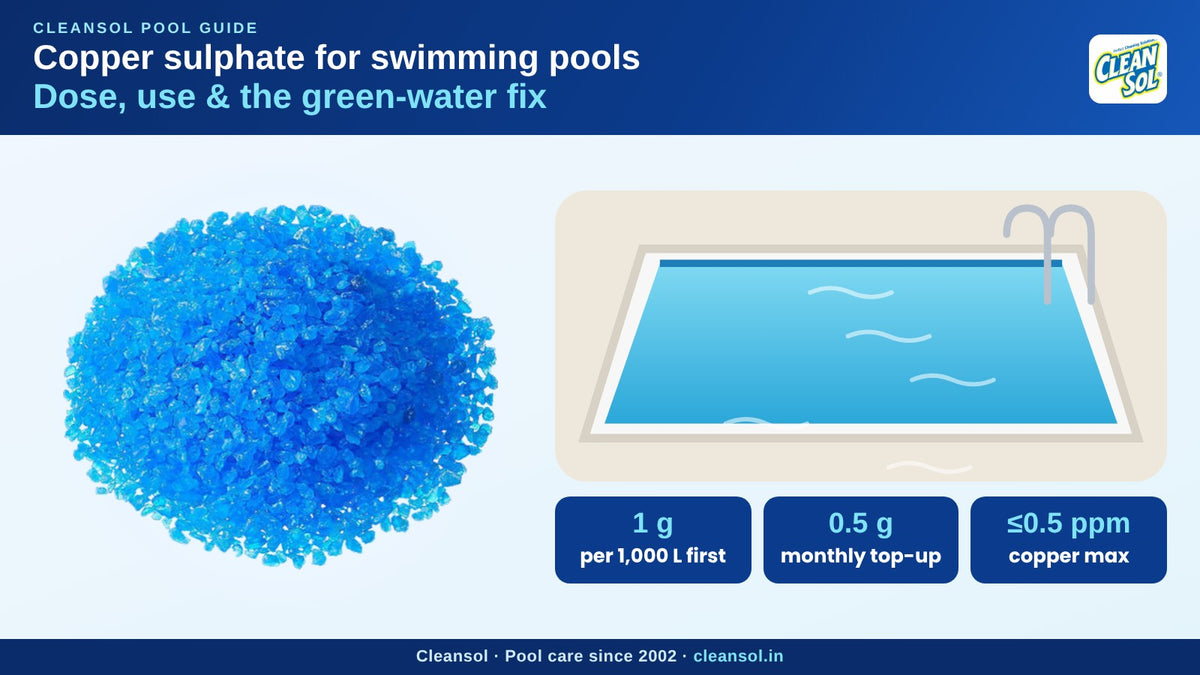
1 g
per 1,000 L – first dose
0.5 g
per 1,000 L – monthly
0.2–0.4 ppm
copper in the water
pH 7.2–7.6
always

Quick answer: Add 1 g of copper sulphate per 1,000 litres of pool water as the first dose (a 50,000 L pool needs 50 g), dissolved in a plastic bucket and poured in front of the return jets with the pump running. After that, add only 0.5 g per 1,000 L once a month. Keep pH at 7.2–7.6 and copper at 0.2–0.4 ppm. Never add the full dose every month – copper builds up and turns the water green-blue.
In this guide
What copper sulphate does in a pool

When copper sulphate dissolves, it releases copper ions. Algae cells cannot grow when copper is around, so green, black and mustard algae find it hard to get started on walls, steps and in corners. Unlike chlorine – which is burnt off by sunlight and swimmers within a day – copper stays in the water for weeks. That makes it a cheap, long-lasting back-up against algae.
Copper does not replace chlorine. It kills algae slowly and does almost nothing against bacteria. Keep free chlorine at 2–3 ppm every day with TCCA 90, and use copper only as a monthly algae guard.
The right dose: simple maths for any pool

Copper sulphate pentahydrate (98%) is about 25% copper. So 1 g in 1,000 litres gives about 0.25 ppm copper – right in the safe working range of 0.2–0.4 ppm. Above 0.5 ppm, copper starts to stain and colour the water.
Step 1 – find your pool volume: length × width × average depth (in metres) × 1,000 = litres. Example: 10 m × 5 m × 1.0 m = 50,000 litres.
| Pool | Water | First dose | Monthly top-up |
| Plunge pool | 10,000 L | 10 g | 5 g |
| Small home pool | 25,000 L | 25 g | 12.5 g |
| Villa pool 10 × 5 × 1 m | 50,000 L | 50 g | 25 g |
| Society pool | 1,00,000 L | 100 g | 50 g |
| Hotel pool | 2,00,000 L | 200 g | 100 g |
| Club / 25 m pool | 4,00,000 L | 400 g | 200 g |
Weigh the dose on a kitchen scale – a level tablespoon of powder is only about 12–15 g, and guessing with a mug is how most overdoses happen. For a 50,000 L pool, a full year (first dose plus 11 monthly top-ups) uses only about 325–350 g.
How to add copper sulphate – step by step

- Test first. Set pH to 7.2–7.6 and free chlorine to 2–3 ppm. If algae is already growing, shock and clear the pool before adding copper.
- Weigh the dose from the chart above.
- Dissolve it fully in a plastic bucket of water. Never use an iron, steel or aluminium bucket or scoop – copper sulphate attacks these metals.
- Pour slowly in front of the return jets with the pump running, walking around the pool.
- Run the pump for at least 8 hours, ideally overnight. Swim after about 4 hours, once it has fully mixed.
- Repeat with the half dose once a month – not the full dose. Always wait 24 hours after a chlorine shock before adding copper.
"I added copper sulphate and my pool turned green" – why it happens
This is the number-one copper complaint, and it is almost never a quality problem. Copper stays dissolved and invisible only while the dose is low and the pH is right. When either goes wrong, the copper comes out of the water as a green-blue tint and stains. These are the four causes we see most:
| Cause | What you see | What to do |
| Full dose every month | Clear but green-blue or teal water that slowly gets worse | Stop copper for 2–3 months; drain and refill 30–50% if strong |
| pH above 7.8 | Cloudy green water, blue-green or dark stains on tiles and steps | Bring pH to 7.2–7.4, brush and filter |
| Added right after a chlorine shock | Water suddenly turns green or brown within hours | Wait 24 hours after any shock before adding copper |
| Algae was already growing | Slimy walls, cloudy green water | Copper only prevents algae – shock with chlorine first |
Remember: chlorine is used up every day, so you add it every day. Copper is not used up – it stays and adds up. Three full monthly doses can push a pool from 0.25 ppm to over 0.6 ppm without anyone noticing, until the water turns teal.
Algae green or copper green? Spot the difference

| Check | Algae green | Copper green |
| Water | Cloudy, murky | Clear, with a teal / green-blue tint |
| Walls | Slimy, slippery | Smooth – may have blue-green or dark stains |
| Free chlorine | Low or zero | Normal – often appears right after a shock |
| Hair | No change | Blonde or light hair turns greenish |
| Fix | Shock with chlorine, brush, filter | Stop copper, lower pH, filter, partial refill |
If it is algae, follow our full green pool rescue plan. If it is copper, read on.
How to fix copper-green water and stains

Green-blue water:
- Stop adding copper for 2–3 months.
- Bring pH down to 7.2–7.4 with Cleansol pH Down and hold it there – at high pH copper keeps coming out of the water.
- Run the pump 24 hours and backwash the filter.
- If the water is hazy, use Pool Floc, let it settle overnight with the pump off, and vacuum to waste.
- Still teal after a week? Drain and refill 30–50% with fresh water – the only way to remove extra copper.
- Restart copper only at the half dose, after testing.
Stains on tiles: rub a crushed vitamin C (ascorbic acid) tablet on the stain for 30 seconds. If it fades, it is a metal stain, not algae – brush it with a pool tile cleaner and keep pH at 7.2–7.4 so it does not return. Algae stains do not fade with vitamin C but do lift with chlorine and brushing.
Green hair: wet your hair with tap water before swimming (dry hair soaks up pool water), wash it soon after, and keep copper below 0.4 ppm.
"Jo paani ko blue kar de" – don't use copper sulphate to colour the water
Many pool owners ask us for "the blue powder that turns the water blue". Copper sulphate is blue, so it is easy to think more powder means bluer water. It does not work that way – and it is dangerous. At the correct dose (1 g per 1,000 L) the water does not change colour at all. To actually see a blue tint, you would need many times the safe amount of copper.
Never add copper sulphate just to make the water look blue. That much copper turns the water green-blue within days, stains tiles and steps, turns hair green, irritates swimmers' eyes and skin, and harms birds and any fish that drink or live in the water. It is also the most common reason customers tell us "the pool turned green".
Where does the beautiful blue colour really come from? From clean, crystal-clear water over white or blue tiles, reflecting the sky. Keep chlorine at 2–3 ppm, pH at 7.2–7.6, run the filter every day and brush the walls – the water will look blue on its own. Copper's only job is to keep algae away.
Open pools: pigeons and other birds drink the water
In open-air pools, pigeons, crows, sparrows and other birds regularly drink and bathe at the edge – especially in Indian summers. This matters in two ways:
- Keep copper low. At 0.2–0.4 ppm it is a very small amount, but overdosing to "make it blue" puts much more copper in the water the birds drink. Stick to the dose chart and never go above 0.5 ppm.
- Birds bring dirt and germs. Droppings and feathers carry bacteria and algae spores and use up chlorine faster. Keep free chlorine at 2–3 ppm, skim the surface every morning, brush the edges and clean droppings off the deck before they wash in.
When not to use copper sulphate
- Fish ponds, aquariums and lakes – copper is very toxic to fish and water life.
- Pools sanitised with biguanide (PHMB) instead of chlorine – copper reacts with it.
- Salt-chlorinator pools – copper can coat the salt cell; ask your equipment supplier first.
- Borewell water with high iron or copper – your water may already carry metals; test before adding more.
- To clear a green pool – copper prevents algae, it does not remove an algae bloom.
A simple routine for clear blue water

| When | What to do |
| Daily | Test chlorine and pH · TCCA 2–3 g per 1,000 L · pump 8+ hours · skim leaves |
| Weekly | Brush walls and steps · vacuum · backwash · check alkalinity 80–120 ppm |
| Monthly | Copper sulphate 0.5 g per 1,000 L · test copper 0.2–0.4 ppm · test stabiliser 30–50 ppm |
| Every season | Partial water change if stabiliser is high · check filter sand · deep-clean tiles |
Copper Sulphate for Pools – 98% pure, with pool-sized dosing
Bright blue crystal powder in 1 kg, 5 kg and 25 kg packs, supplied from Jodhpur since 2002. Use it with TCCA 90 for daily chlorine and the pH & Chlorine Test Kit to keep pH right.
Shop Copper Sulphate →Frequently asked questions
How much copper sulphate should I put in my pool?
1 g per 1,000 litres as the first dose, then 0.5 g per 1,000 litres once a month. A 50,000 L pool needs 50 g first and 25 g a month after that.
How often should I add copper sulphate to a swimming pool?
Once a month at the half dose. Copper is not used up like chlorine, so adding the full dose every month makes it build up.
Can copper sulphate clear a green pool?
No. It prevents algae but does not clear an algae bloom quickly. Shock with chlorine, brush and filter until clear, then add copper 24 hours later.
Why did my pool turn green after adding copper sulphate?
Too much copper (a full dose added again and again), pH above 7.8, or copper added right after a chlorine shock. Stop copper, lower pH to 7.2–7.4 with Cleansol pH Down, filter, and partly refill if the colour stays.
Is copper sulphate safe for swimmers?
At 0.2–0.4 ppm, copper is far below the WHO drinking-water guideline of 2 mg per litre. Wait until it has fully mixed – about 4 hours with the pump running – before swimming.
Will copper sulphate turn my hair green?
Not at the correct dose with pH 7.2–7.6. Green hair happens when copper goes above about 0.5 ppm or the pH is high.
Can I mix copper sulphate with chlorine?
Both can be in the pool together, but never mix them in the same bucket, and wait 24 hours after a chlorine shock before adding copper.
How do I test copper in my pool?
Use copper test strips or a copper test kit once a month. Keep copper at 0.2–0.4 ppm and stop dosing if it is above 0.5 ppm.
Can I use copper sulphate to make my pool water blue?
No. At the safe dose it does not change the colour. Enough copper to tint the water is an overdose – it turns the water green-blue, stains tiles, turns hair green and harms birds and fish. Blue water comes from clean, clear, well-filtered water.
Birds drink from my open pool – is copper safe for them?
Keep copper at the low 0.2–0.4 ppm level and never overdose. Birds also bring germs and algae spores, so keep chlorine at 2–3 ppm and skim and clean the edges daily.
Is pool copper sulphate the same as neela thotha?
Yes – both are copper sulphate. Our pool pack comes with pool-specific dosing and pool-sized packs. For farming and other uses, see Copper Sulphate (Neela Thotha).
Dosing information in this guide is general guidance for chlorinated swimming pools; always follow your test readings and local regulations. Questions? WhatsApp our team on 98290 05860.