
Cleansol Guide · Pool Care
How to use pool floc: clear a green or cloudy pool overnight – dose, steps and the milky-water fix
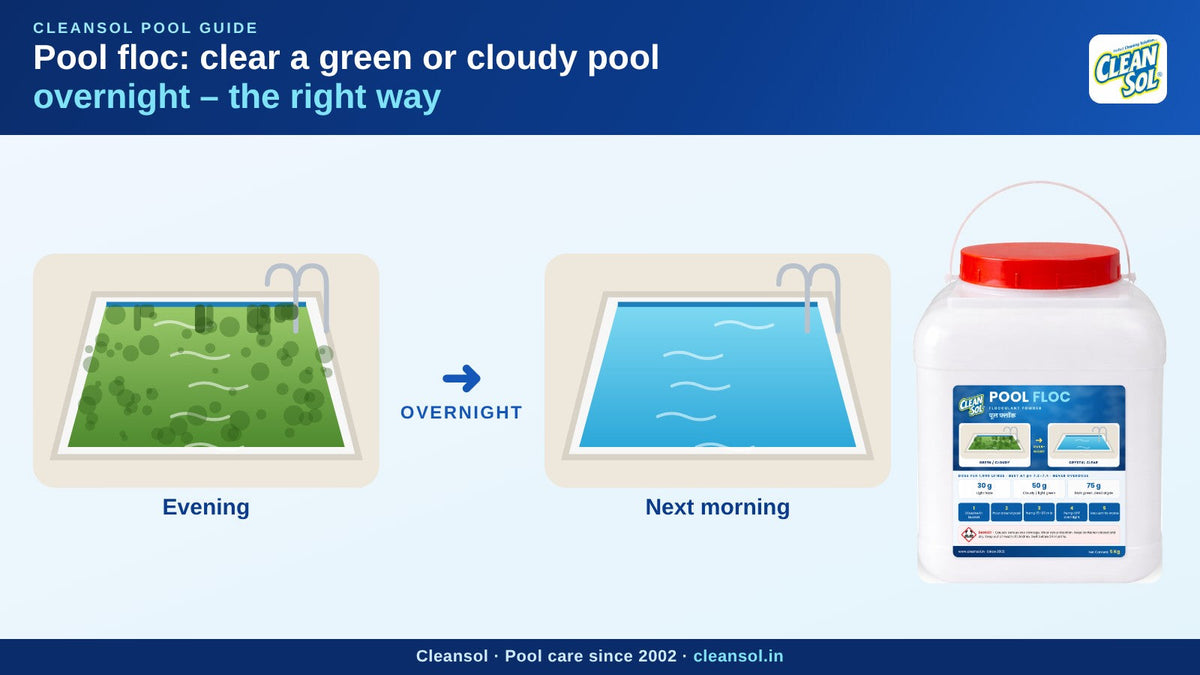
Pool floc (flocculant) is the fastest way to turn a cloudy, milky or green pool crystal clear – usually by the next morning. We have supplied pool floc in tons to pools, hotels and contractors for years, and nearly every “it didn’t work” call comes down to the same few mistakes: wrong pH, too much floc, the pump left running, or vacuuming through the filter. This guide shows the exact dose by water colour, the overnight method step by step, and what to do if the pool turns milky after adding too much.
30–75 g
per 1,000 L by colour
pH 7.2–7.4
for best flakes
15–20 min
pump to mix
8–12 hours
settle overnight
Quick answer: Set pH to 7.2–7.4 and alkalinity to 80–120 ppm (shock with chlorine first if the pool is green). Dissolve 30 g per 1,000 L for a light haze, 50 g for cloudy or light green, or 75 g for dark green water in a bucket, pour it around the pool, run the pump on Recirculate for 15–20 minutes, then switch it off overnight. Next morning, vacuum slowly to waste – never through the filter.
In this guide
What pool floc does – and floc vs clarifier

Cloudy water is full of particles far smaller than a grain of sand – so small that they pass straight through a sand filter. Floc joins them into bigger, heavier flakes that sink to the floor while the pump is off. You then vacuum them out of the pool. A clarifier does a gentler job: it clumps particles just enough for the filter to catch them over several days. Use floc when the water is very cloudy or green and you want it clear fast; use a clarifier for a light haze when you don’t want to vacuum.
Why the pool turns cloudy or milky

In Indian conditions the most common causes are dead algae after a chlorine shock, dust and sand storms, rain run-off, running the pump only 2–3 hours a day, high pH or hard borewell water, and heavy use. Floc removes the particles – but if chlorine or pH are off, fix those too or the water will cloud again.
How much floc? Dose by colour

| Pool | Water | Light haze (30 g / 1,000 L) | Cloudy / light green (50 g) | Dark green (75 g) |
| Plunge pool | 10,000 L | 300 g | 500 g | 750 g |
| Small home pool | 25,000 L | 750 g | 1.25 kg | 1.9 kg |
| Villa pool | 50,000 L | 1.5 kg | 2.5 kg | 3.75 kg |
| Society pool | 1,00,000 L | 3 kg | 5 kg | 7.5 kg |
| Hotel pool | 2,00,000 L | 6 kg | 10 kg | 15 kg |
Pool volume = length × width × average depth (metres) × 1,000. Weigh the dose – guessing with a mug is how most overdoses happen. Never add more than 100 g per 1,000 L at one time.
The overnight method – step by step

- Day before – prepare. Set pH to 7.2–7.4 and alkalinity to 80–120 ppm. If the pool is green, shock it with Sodium Hypochlorite – floc settles dead algae, not living algae.
- Evening – dose. Dissolve the floc fully in a bucket of pool water and pour it evenly around the whole pool.
- Mix 15–20 minutes. Run the pump on Recirculate just long enough to mix it through the water.
- Pump OFF overnight. Leave the pool completely still for 8–12 hours – no swimming, no pump.
- Morning – vacuum to waste. Vacuum slowly so the settled layer is not stirred up. Top up the water, backwash the filter and re-test chlorine and pH.
Which multiport valve setting, when?

| Stage | Valve setting | Why |
| Mixing the floc | Recirculate | Water bypasses the sand, so the floc stays in the pool |
| Settling overnight | Pump off | Still water lets the flakes sink |
| Vacuuming | Waste / Drain | Dirt goes out of the pool, not into the filter |
| After vacuuming | Backwash → Rinse → Filter | Cleans the sand and returns to normal running |
No multiport valve? Vacuum with a pump-to-waste or a separate submersible pump. Vacuuming the settled floc through a cartridge or sand filter clogs it and sends the fine dirt straight back into the pool.
The best pH for pool floc
| pH | What happens |
| Below 7.0 | Tiny, weak flakes – water stays hazy |
| 7.2–7.4 | Best result – big, heavy flakes settle overnight |
| 7.5–7.6 | Good result |
| Above 7.8 | Flakes form poorly, milky haze and scaling |
Floc also lowers pH and alkalinity a little as it works. In soft or low-alkalinity water this can stop it working, so bring alkalinity to 80–120 ppm with Cleansol Alkalinity Up and pH up with Cleansol pH Up – or down with Cleansol pH Down – before you dose.
Added too much floc? Pool turned milky – the fix

Adding extra floc “to be sure” is the most common mistake we see. Extra floc that has nothing to grab forms a fine, light haze that floats instead of settling – and because it also pulls pH and alkalinity down, the haze keeps floating. So the turbidity comes from the overdose and the pH together. Fix it in this order:
- Stop – don’t add more floc.
- Correct the balance: alkalinity 80–120 ppm with Cleansol Alkalinity Up, pH 7.2–7.4 with Cleansol pH Up.
- Run the filter 24 hours a day – once the pH is right, the sand traps the haze.
- Backwash every 8–12 hours or whenever the pressure rises – extra floc clogs the sand fast.
- If flakes start to form, switch the pump off overnight and vacuum to waste.
- Still milky after 2–3 days? Replace 20–30% of the water with fresh water and rebalance.
Cleansol Pool Floc Powder – clear water by morning
Trusted by pools, hotels and contractors for years. 5 kg bucket and 25 kg bag, supplied from Jodhpur since 2002. Shock first with Sodium Hypochlorite, keep it clear with daily TCCA 90 and stop algae returning with Copper Sulphate for Pools.
Shop Pool Floc →Frequently asked questions
How much pool floc should I use?
30 g per 1,000 L for a light haze, 50 g for cloudy or light green water and 75 g for dark green water. A 50,000 L pool needs 1.5–3.75 kg.
How long does pool floc take to work?
Mix for 15–20 minutes, then leave the pump off for 8–12 hours. Most pools are ready to vacuum the next morning.
Can floc clear a green pool on its own?
No. Shock with chlorine first to kill the algae, then use floc to settle the dead algae.
Why is my pool still cloudy after using floc?
Usually the pH was too low or too high, the pump was left running, the settled layer was vacuumed through the filter, or too much floc was added. Correct pH to 7.2–7.4 and follow the fix above.
I added too much floc and the pool is milky. What now?
Stop adding floc, correct alkalinity and pH, run the filter 24 hours a day and backwash every 8–12 hours. If it is still milky after 2–3 days, replace 20–30% of the water.
Should I vacuum to waste or to filter?
Always to waste. Vacuuming settled floc through the filter clogs it and sends the dirt back into the pool.
Can I swim after adding floc?
Only after the settled layer has been vacuumed out and chlorine and pH are back in range.
Floc or clarifier – which is better?
Floc is faster (overnight) but needs vacuuming. A clarifier is slower (2–4 days) and works through the filter. For very cloudy or green water, floc is the better choice.
Dosing information in this guide is general guidance; always follow your water condition and test readings. Questions? WhatsApp our team on 98290 05860.