Cleansol Guide · Floor & Toilet Care
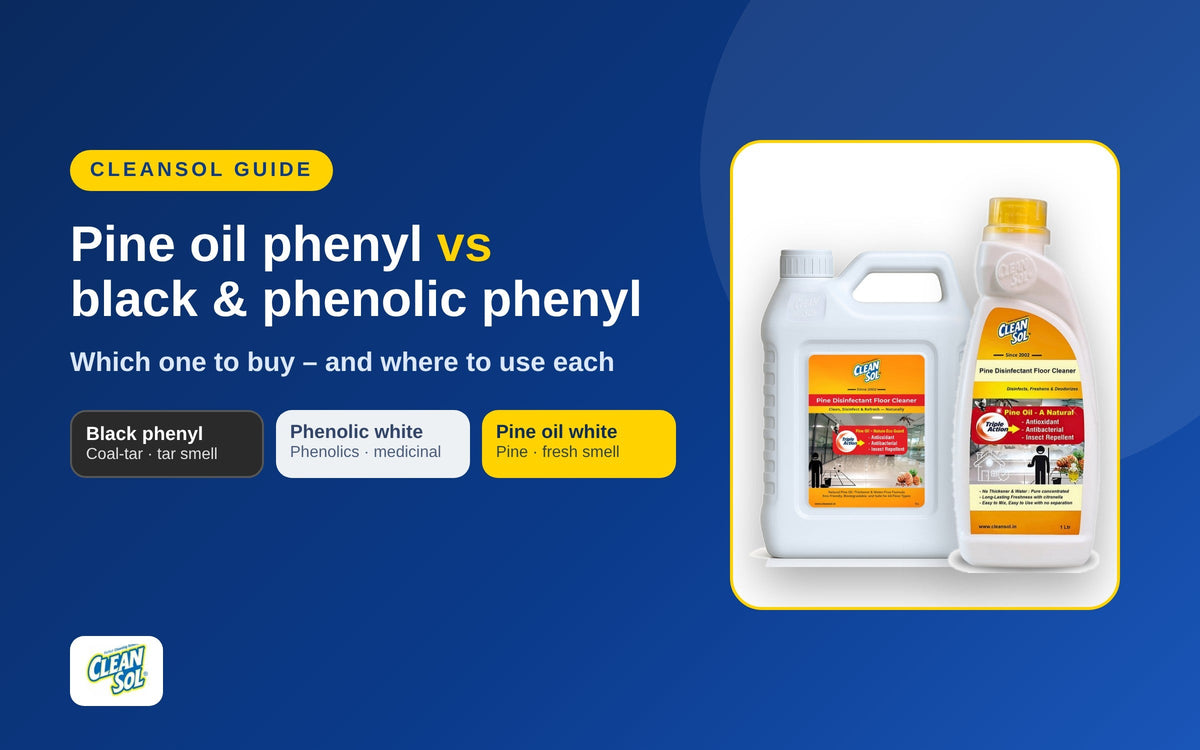
Pine oil phenyl vs black phenyl vs phenolic white phenyl – which should you buy?
In India, "phenyl" can mean three very different products. They look alike in the bucket – all of them turn the water milky – but they are made from different chemicals, smell different and suit different places. Here is how to tell them apart and choose the right one.
3 types
all sold as "phenyl"
42%
pine oil grade to look for
1 : 9
1 L makes 10 L phenyl
No tar
clean pine smell
Quick answer: For homes, offices, hotels and hospitals, choose a pine oil white phenyl – it cleans and controls odour with a fresh pine smell that does not linger like tar. Black phenyl and phenolic white phenyl are made from coal-tar phenolic chemicals; they have a heavy medicinal or tar smell and are better kept to drains, gutters and outdoor areas. For daily mopping of living rooms, a mild neem floor cleaner is the most pleasant choice.
In this guide
The 3 kinds of phenyl sold in India
TYPE 1
Black phenyl
Made from coal-tar acids – phenolic chemicals such as cresols – mixed with soap. A dark brown-black liquid with a strong tar, "carbolic" smell that stays in the room for hours.
TYPE 2
Phenolic white phenyl
The same family of coal-tar phenolic chemicals, made into a white emulsion. White in the bottle and in the bucket, with a heavy medicinal "hospital" smell. Some brands add a pine perfume on top.
TYPE 3
Pine oil white phenyl
Made with pine oil – an oil distilled from pine – blended so it mixes with water. Turns milky white in water, with a fresh, clean pine smell and no coal-tar chemicals.
Phenolic phenyls (types 1 and 2) are usually labelled with an RWC number (Rideal-Walker coefficient) – a laboratory comparison with phenol. Pine oil phenyls are judged by their pine oil grade, such as 22%, 32% or 42%.
Side-by-side comparison
| Black phenyl | Phenolic white phenyl | Pine oil white phenyl | |
| Made from | Coal-tar phenolics + soap | Coal-tar phenolics, emulsified | Pine oil, emulsified |
| In the bottle | Dark brown-black | White | Oil concentrate – no water added |
| In water | Milky | Milky white | Milky white |
| Smell | Strong tar, lingers | Heavy medicinal | Fresh pine, settles when dry |
| On hands | Harsh – gloves needed | Harsh – gloves needed | Gloves for long use |
| Indoors | Not ideal – smell stays | Smell stays in rooms | ✓ Toilets, bathrooms, corridors, wards |
| Best for | Open drains, gutters, outdoor areas | Drains, outdoor toilets | Homes, hospitals, hotels, schools, offices |
| Graded by | RWC number | RWC number | Pine oil % (22 / 32 / 42) |
Why "it turns milky" proves nothing
Many buyers test phenyl by pouring it in water: if it turns white, it must be good. In fact all three types turn milky, because each is an oil blended to mix with water. Even a phenyl with very little active ingredient can look white. The milky colour only tells you the product mixes well – not what is inside or how strong it is.
The better tests: read the label for what it is made from (pine oil and its grade, or phenolics and RWC), and smell it. Pine oil smells of fresh pine; phenolics smell of tar or hospital disinfectant, even when a pine perfume is added on top.
Pine oil grades: 22%, 32% and 42%
Not all pine oil phenyls are equal. Pine oil is sold in grades by its content of terpene alcohols – the part of pine oil that does the cleaning and odour control. The higher the grade, the more of this useful part, and the less harsh turpentine-like oil.
22%
Cheapest grade – common in low-price phenyl
32%
Middle grade – most market phenyl
42%
High grade – used in Cleansol's concentrate
Read more on grades in our guide: How to make white phenyl from pine oil – and why 42% matters.
5 checks before you buy phenyl
- Base: does the label say pine oil, or phenolics / cresols / "black disinfectant fluid"?
- Grade: for pine oil phenyl, look for the pine oil % – 42% is a high grade.
- Thick does not mean strong: thickness often comes from thickener and water, which can leave a sticky film on floors.
- Concentrate or ready-to-use: a concentrate that makes 10 L costs far less per bucket than ready phenyl that is mostly water.
- Smell test: fresh pine, not tar or a sharp hospital smell hidden under perfume.
Which one where?
LIVING ROOMS & KITCHENS
Neem floor cleaner
Mild herbal fragrance for everyday mopping of the rooms you live in.
TOILETS, BATHROOMS, INSTITUTIONS
Pine Oil 42% White Phenyl
Toilets, bathrooms, dustbins, corridors, hospitals, hotels, hostels and schools.
OPEN DRAINS & OUTDOORS
Phenolic phenyl, if you use it
Keep black and phenolic phenyl outdoors, where the heavy smell does not matter. Pine oil phenyl works here too.
Need tested disinfection? After illness, in isolation areas or where a tested disinfectant is required, use a registered disinfectant such as sodium hypochlorite at the right dilution, and follow the label. Never mix it with phenyl or any other cleaner.
How to use pine oil phenyl concentrate
- Make your phenyl: 1 part concentrate + 9 parts water – for example 1 L + 9 L = 10 L of white phenyl.
- Mopping: 1 cup (200–250 ml) of made phenyl in a 10 L bucket – or 1 cap (20–25 ml) of concentrate straight into the bucket.
- Toilets & bathrooms: pour made phenyl into the bowl and on the floor, scrub and flush.
- Drains & dustbins: pour 100–200 ml of made phenyl to control odour.
Suitable for tiles, ceramic, mosaic, terrazzo, kota and cement floors. Test first on polished marble and granite.
Frequently asked questions
Cleansol Pine Oil 42% White Phenyl Concentrate
42% pine oil distilled from pine · No coal-tar · No thickener · 1 L makes 10 L · 1 L to 50 L packs.
Shop Pine Oil White Phenyl → Neem Floor Cleaner →Related: How to make white phenyl from pine oil · Neem floor cleaner vs phenyl · How to clean every type of floor
General information about product types sold in the market; it does not refer to any particular brand. Always follow the product label and keep cleaners away from children and pets.