Cleansol Guide · Floor Cleaning
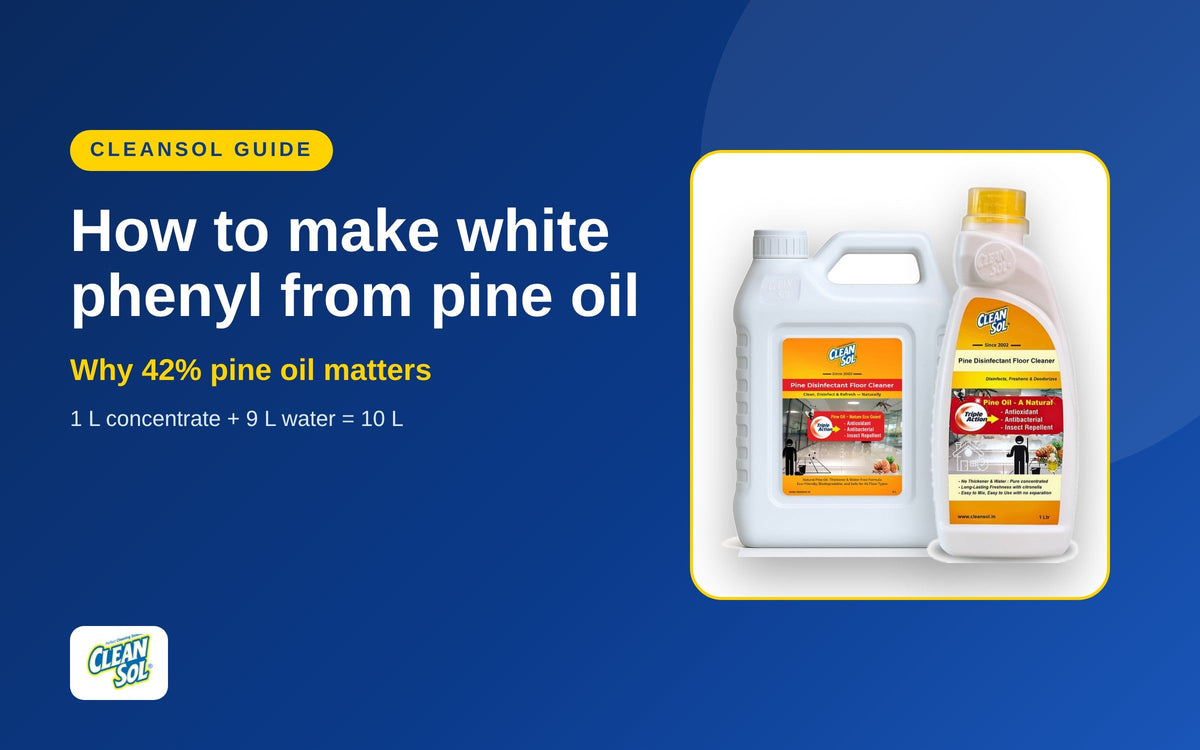
How to make white phenyl from pine oil concentrate – and why 42% pine oil matters
Most phenyl sold in India looks thick but is mostly water, thickener and low-grade pine oil. Here is what the “%” on pine oil really means, how to make 10 litres of milky-white phenyl from 1 litre of concentrate, and how much to use for floors, toilets and drains.
1 + 9
concentrate + water
10 L
phenyl from 1 L
1 cup
per 10 L bucket
42%
pine oil grade
Quick answer: Pour 9 parts water into a clean can, add 1 part pine oil concentrate and shake – it turns milky white straight away. That is your white phenyl. Use 1 cup (200–250 ml) per 10 L bucket for mopping, pour it neat into toilets, and 100–200 ml into drains and bins. Shortcut: add 1 cap (20–25 ml) of concentrate directly to a 10 L bucket.
In this guide
What is white phenyl?
White phenyl is the milky-white floor cleaner used in almost every Indian home, hospital, school and office. It is made by mixing pine oil with an emulsifier, so that the oil spreads evenly in water and turns it white. Its job is everyday cleaning of floors, toilets, bathrooms and drains – and leaving behind that familiar fresh pine smell.
It is different from black phenyl and phenolic white phenyl, which are made from coal-tar chemicals and have a much harsher smell. See our comparison: pine oil phenyl vs black phenyl vs phenolic white phenyl.
What does “42% pine oil” mean?
Pine oil is sold in grades – usually 22%, 32% and 42%. The percentage is the content of terpene alcohols, the part of pine oil that cleans, cuts bad odour and gives pine its long reputation as a hygienic cleaner. The rest is mostly lighter, turpentine-like hydrocarbons.
So the higher the grade, the more of the useful part you get in every drop. Good pine oil is derived from pine and refined by distillation – it is not the same as a synthetic “pine” perfume added to a cheap product to make it smell like pine.
22% vs 32% vs 42% pine oil
| Grade | Where you find it | What you get |
| 22% | Most low-price phenyls | Least active part, harsher smell, often boosted with perfume |
| 32% | Mid-range phenyls | Better, but still diluted with water and thickener |
| 42% | Premium concentrates | Most active pine oil, rich white bloom, strong clean pine smell |
Why thick phenyl is not strong phenyl
Many buyers judge phenyl by how thick it looks in the bottle. But in most market phenyls, the thickness comes from water plus a thickener (and a cheap oil called TRO) – not from pine oil. You are paying to carry water home.
Ordinary ready phenyl
- 22–32% grade pine oil
- Mostly water
- Thickened with TRO and thickener
- Thickener can leave a sticky, streaky film on floors
Pine oil concentrate
- 42% grade pine oil
- No water – you add it yourself
- No thickener, no TRO
- Dries clean and streak-free
How to make white phenyl at home
- Take a clean bottle or can – rinse out any old cleaner first.
- Add 9 parts plain tap water. Water first, then concentrate, gives a smoother white mix.
- Add 1 part concentrate. Example: 100 ml concentrate + 900 ml water = 1 litre of white phenyl.
- Close and shake for a few seconds. It turns milky white straight away.
- Label the can “White phenyl – for floor cleaning” and store it away from children.
Mixing chart
| Concentrate | Water | White phenyl made |
| 100 ml | 900 ml | 1 litre |
| 500 ml | 4.5 litres | 5 litres |
| 1 litre | 9 litres | 10 litres |
| 5 litres | 45 litres | 50 litres |
| 25 litres | 225 litres | 250 litres |
How much to use
🧽 Mopping floors
1 cup (200–250 ml) of white phenyl in a 10 L bucket. Double it for heavy-use areas.
🚽 Toilets & bathrooms
Pour white phenyl neat into the bowl and on wet floors, scrub and flush.
🕳️ Drains & dustbins
Pour 100–200 ml to control bad odour.
⚡ Shortcut
Skip step 1: add 1 cap (20–25 ml) of concentrate straight to a 10 L bucket.
Suitable for tiles, ceramic, mosaic, terrazzo, kota and cement floors. Test first on a small hidden spot of polished marble or granite.
The milky-white test
Put a few drops of any phenyl into a glass of water. A good pine oil concentrate blooms into a rich, even milky white straight away. A weak phenyl gives a thin, cloudy or bluish mix – a sign that there is little pine oil in it.
But remember: phenolic (coal-tar) phenyls also turn milky white, so colour alone does not prove pine oil. Check the label for the pine oil % and smell it – genuine pine oil smells of fresh pine, not tar or a hospital. How to tell the 3 kinds of phenyl apart →
Real cost per bucket
Because you add the water yourself, 1 litre of concentrate makes 10 litres of white phenyl – about 40 mopping buckets. At Cleansol website prices that works out to roughly ₹16 a bucket on the 1 L pack, and less on bigger packs (about ₹33 per litre of ready phenyl on the 50 L pack).
Mistakes to avoid
✓ Do
- Always dilute before use
- Wear gloves for long cleaning sessions
- Keep the cap tightly closed
- Store below 40 °C, out of sunlight
- Keep away from children and pets
✕ Don't
- Don't use the concentrate neat on floors or skin
- Don't keep it near a gas stove or flame – it is combustible
- Don't mix with bleach, acids or other cleaners
- Don't use more than needed – it won't clean better
- Not for drinking
Frequently asked questions
Cleansol Pine Oil 42% White Phenyl Concentrate
No water · No thickener · 1 L makes 10 L · Packs from 1 L to 50 L for homes, hospitals, hotels and societies.
Shop Pine Phenyl Concentrate → 💬 WhatsApp 98290 05860Related: Pine oil phenyl vs black & phenolic white phenyl · Neem floor cleaner vs phenyl · How to clean every type of floor – tiles, marble, granite and kota stone
For floor and surface cleaning only. Combustible concentrate – keep away from flames. Keep out of reach of children.