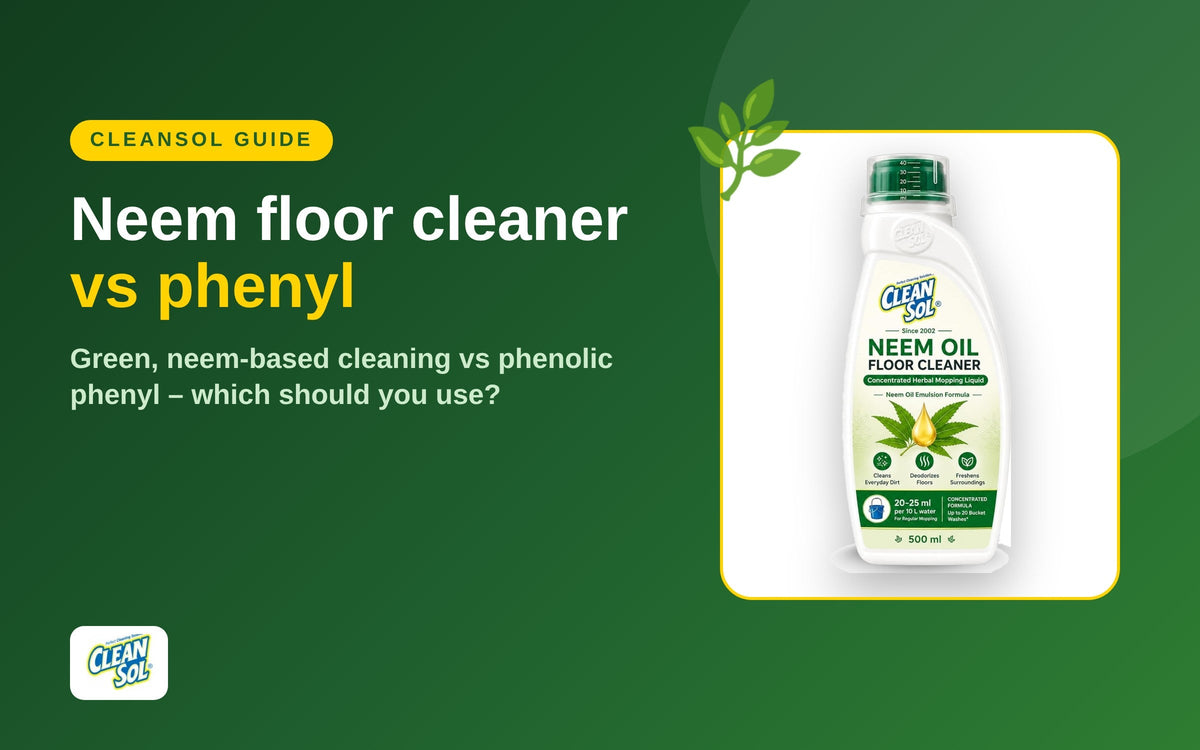
Cleansol Guide · Floor Care
Neem floor cleaner vs phenyl – which should you use?
For generations, Indian homes trusted neem to keep the house fresh and clean. Then came the strong smell of phenyl. Today you can choose – here is how green, neem-based floor cleaning compares with black and white phenyl, and where each one belongs.
2,000+ yrs
neem in Indian homes
1 cap
per 10 L bucket
Mild
herbal fragrance
Use both
neem + pine phenyl
Quick answer: Use a neem-based floor cleaner for daily mopping of living rooms, bedrooms and kitchens – it has a mild herbal fragrance and is pleasant to use every day. Keep phenyl for toilets, drains, bins and heavy-use areas, where a strong product is wanted. Avoid tar-smelling black phenyl inside living spaces.
In this guide
Neem – India's "village pharmacy"
The neem tree (Azadirachta indica) is native to the Indian subcontinent, and few plants are as woven into Indian life. Ayurveda calls it "Sarva Roga Nivarini" – the one that keeps away all ailments – and it is often described as the "village pharmacy", because almost every part of the tree, from leaf to bark to seed oil, has a traditional use.
Long before bottled cleaners existed, Indian households turned to neem to keep the home fresh and clean. That trust, built over generations, is why neem still means "clean and pure" to so many families today.
Neem in everyday Indian life
🌿 Leaves at the doorway
Neem leaves hung at the door and used in rituals, especially in summer and during festivals.
🪥 Neem datun
Neem twigs chewed for oral care – still a morning habit in many villages.
🌾 Grain and clothes stores
Dried neem leaves kept with stored grain, books and woollens.
🛁 Neem bath water
Neem leaves boiled in bath water – a home tradition passed down by grandmothers.
🎉 Gudi Padwa & Ugadi
Neem with jaggery eaten at the new year – bitter and sweet, for the year ahead.
🏠 Cleaning the home
Neem water used to wash floors and courtyards for a fresh, clean home.
What modern research says
Neem is one of the most studied plants in the world. Laboratory studies have looked at the antibacterial and antifungal properties of neem leaf and seed-oil extracts, and neem oil is widely used in soaps, personal care and agriculture.
Please note: research on neem extracts is not the same as a test of a finished floor cleaner. Cleansol Neem Oil Floor Cleaner is a cleaning product for everyday mopping – it is not sold or tested as a disinfectant. For disinfection, use a registered disinfectant such as sodium hypochlorite at the right dilution.
What phenyl actually is
"Phenyl" is the everyday Indian name for two quite different products:
Black phenyl
Made from coal-tar acids – phenolic compounds such as cresols – mixed with soap. Dark brown concentrate, very strong tar smell that lingers. Traditionally used in drains, toilets and outdoor areas.
White phenyl
Turns milky white in water. Made with pine oil (some brands also add phenolic compounds). Strong pine or "phenyl" smell. Used in toilets, hospitals and institutions.
Phenolic products work hard, but their strong smell stays in the room, they are harsh on hands, and they should be kept well away from children and pets – cats in particular are known to be sensitive to phenols.
Neem floor cleaner vs black and white phenyl
| Black phenyl | White phenyl | Neem floor cleaner | |
| Base | Coal-tar phenolics | Pine oil (some with phenolics) | Neem oil emulsion |
| Smell | Strong tar, lingers | Strong pine / phenyl | Mild herbal neem |
| On hands | Harsh – gloves needed | Gloves for long use | Mild at mopping dilution |
| Living rooms & bedrooms | Not ideal – smell stays | OK, but strong smell | ✓ Made for it |
| Toilets & drains | Traditional choice | ✓ Good choice | Use phenyl here |
| Dose | As per label | 1 cup per bucket | 1 cap (20–25 ml) per 10 L |
Which one where? – the smart way to use both
DAILY MOPPING
Neem floor cleaner
Living room, bedrooms, kitchen, balcony, pooja room, entrance.
HEAVY-DUTY AREAS
Pine Oil 42% White Phenyl
Toilets, bathrooms, drains, dustbins, hospitals, hostels.
Cleansol's white phenyl is made with 42% pine oil distilled from pine – not coal-tar – so you get a strong, clean pine smell for heavy-use areas, and a mild neem freshness for the rooms you live in.
How to use neem floor cleaner
- Sweep or dust first to remove loose dirt.
- Add 1 cap (20–25 ml) to a 10 L bucket of water – half a cap for 5 L. The water turns lightly cloudy: that is the neem oil emulsion.
- Mop as usual and change the water when it gets dirty.
- Let it air-dry – no rinsing needed.
Suitable for tiles, vitrified, marble, granite, mosaic and kota floors. Test first on highly polished stone. Not for wooden or waxed floors.
Frequently asked questions
Cleansol Neem Oil Floor Cleaner
Made with neem oil emulsion · 1 cap per 10 L · mild herbal fragrance · 500 ml to 25 L.
Shop Neem Floor Cleaner → Pine Oil White Phenyl →Related: Pine oil phenyl vs black & phenolic white phenyl · How to make white phenyl from pine oil concentrate · How to clean every type of floor
Traditional uses of neem are described for cultural interest and are not product claims. Always follow the product label and keep cleaners away from children and pets.