Complete Guide · Bathroom
Hard water stains & soap scum on tiles and taps: how to remove them safely
White marks on taps, chalky lines on tiles and crusty shower heads come from the salts in hard water. Here is how to remove them safely – without HCl fumes and without damaging your tiles, grout or chrome.
5–10 min
contact time
150 ml / L
daily spray
2–3 rounds
for old scale
No HCl
no fumes
Quick answer: Wet the surface, apply a thick, HCl-free hard water stain remover neat on the marks, keep it wet for 5–10 minutes, scrub with a nylon brush and rinse well. Old, layered scale needs 2–3 rounds over a few days. To stop it coming back, spray a 150 ml per litre dilution after every bath. Never use it on marble, granite, kota or cement.
In this guide
What hard water stains and soap scum are
Borewell and municipal water in most of India carries dissolved calcium and magnesium. When water dries on a tap or tile, these salts stay behind as a white, chalky film. Every splash adds a new layer, and within months it becomes hard, crusty limescale that soap and detergent cannot lift. Mixed with soap, it forms grey soap scum; in toilets and urinals it builds up as yellow urine salts.
🧂 Hard water scale
Calcium and magnesium left behind when water dries – white spots and a rough, chalky crust.
🧼 Soap scum
Bar soap reacts with the same minerals to form an insoluble "lime soap". With body oils and shampoo it sticks to the scale and turns grey and greasy.
🚽 Urine salts
The same minerals with urine build up as a hard yellow-brown crust in toilets and urinals.
Quick check: rub the film with a wet finger. Rough and chalky = mostly hard water scale. Slippery or greasy = mostly soap scum. Most bathrooms have both – the same cleaner removes both.
Why it builds up so fast in Indian homes: hard borewell and tanker water, splashes left to dry, bar soap (it reacts with hard water more than liquid body wash) and poorly ventilated bathrooms that stay damp.
Hard water, soap scum or rust?
| Stain | Looks like | Where | What removes it |
| Hard water / limescale | White, chalky, crusty | Taps, shower heads, glass, tile joints | Hard water stain remover |
| Soap scum | Grey, greasy film | Shower walls, tubs, basins | Hard water stain remover |
| Urine salts | Yellow-brown crust | Toilets, urinals | Hard water stain remover |
| Rust | Orange-brown spots | Near iron fittings, buckets, borewell water | Oxalic acid – see the rust on tiles guide |
Why not HCl tile acid – what it does to tiles, grout and taps
Hydrochloric (muriatic) acid is the cheap "tile acid" sold in every hardware shop. It dissolves scale fast – but it does not stop at the scale.
🧱 Eats the grout
Cement grout is mineral, like the scale itself. HCl dissolves it too – joints turn sandy, crumble and open up, and water starts seeping behind the tiles.
✨ Dulls the glaze
Repeated strong acid can dull the shine of many glazes, especially matte, rustic and older tiles, and attacks chipped edges. Once the glaze is dull it cannot be polished back.
🚰 Pits chrome taps
Chrome plating is a thin layer. HCl and its fumes attack it – taps get dull patches, pitting and peeling, and the brass shows through.
😷 Choking fumes
In a small closed bathroom the fumes sting the eyes and throat, and they corrode nearby metal – hinges, screws, mirror backs and geyser fittings.
Many daily sprays avoid acid altogether, but they are thin and perfumed – they handle a light film, not real scale.

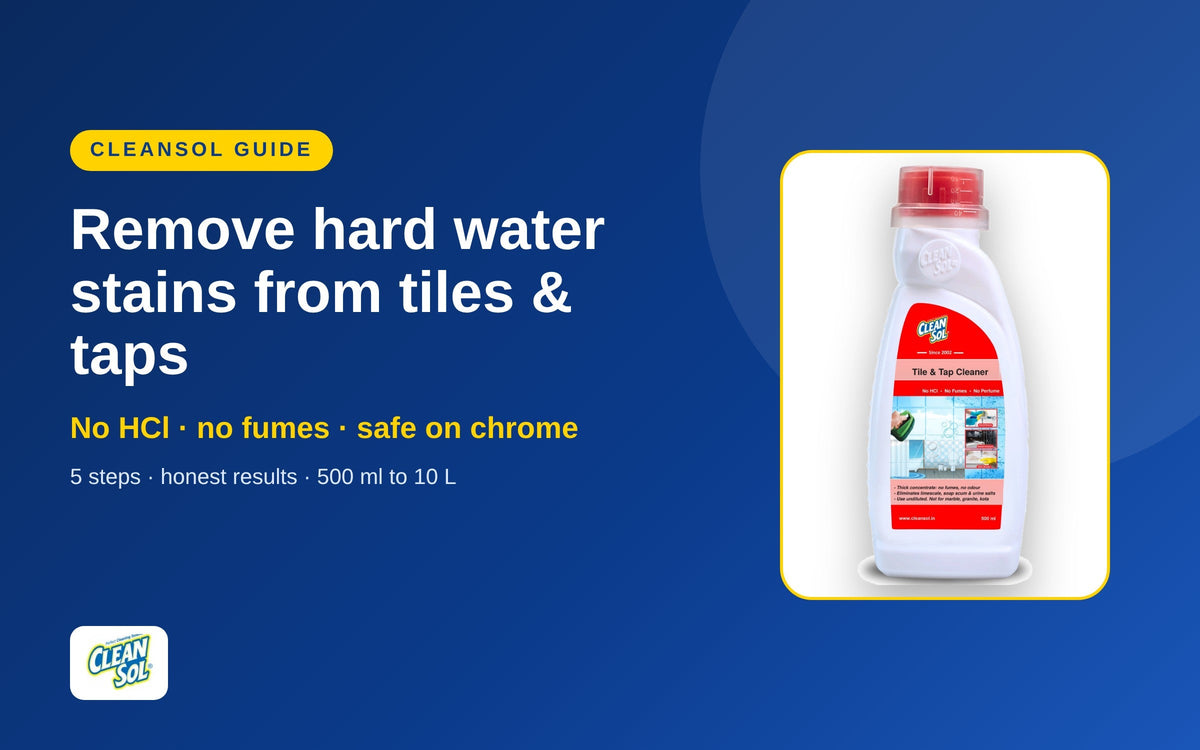
Cleansol Tile & Tap Cleaner is made with no HCl, no bleach, no caustic, no LABSA and no SLES – the foaming detergents most tile cleaners use – and no perfume. It is a thick concentrate that clings to walls and fittings, sold offline for over 20 years with no damage to tiles or taps reported.
Why we keep LABSA and SLES out
LABSA and SLES are cheap foaming detergents used in most tile and floor cleaners. Foam looks powerful, but on tiles it works against you:
Film on the tile surface
Detergent residue stays on the glaze as a thin film that dulls the shine and holds dirt, so tiles look grey again sooner.
Slippery floors
Left-over detergent makes wet bathroom floors slippery.
More rinsing, more water
Heavy foam needs many rinses to clear, and residue left in grout lines attracts grime.
Hides the real result
Foam looks busy even when the scale is not dissolving. A thick, low-foam descaler shows you exactly where it is working.
What you need
🧴 Hard water stain remover
A thick, HCl-free descaler that clings to vertical tiles and taps.
🧤 Rubber gloves
Always wear gloves while cleaning.
🪥 Nylon tile brush
Plus an old toothbrush for tap joints and grout lines.
🧽 Sponge & spray bottle
A sponge to apply, a spray bottle for daily care.
How to remove hard water stains: 5 steps
1
Wet the surface
Splash a little water on tiles or taps first. Work on cool surfaces, not in hot sun.
2
Apply neat
Spread the cleaner directly on the marks with a sponge or brush. Use a toothbrush for tap bases and joints.
3
Wait 5–10 minutes
Keep it wet – add a little more if it starts to dry.
4
Scrub gently
Use a nylon tile brush on tiles and a soft cloth or toothbrush on chrome. Never steel wool or green scrub pads on taps.
5
Rinse well
Rinse with plenty of water and wipe taps dry. Repeat on old scale.

What to expect – honestly
No safe cleaner removes years of scale in one wipe. Here is what is realistic:
| Build-up | Example | Rounds needed |
| Light | Fresh white spots on taps and shower glass | 1 application |
| Medium | Weeks of soap scum and salt marks | 1–2 rounds |
| Heavy | Months or years of thick, layered scale | 2–3 rounds over a few days |

No cleaner can reverse damage already caused by acid, paint or cement – etched or dull patches stay.
Surface by surface
| Surface | How to clean | Note |
| Glazed & vitrified tiles | Apply neat, 5–10 min, nylon brush, rinse | Walls and floors |
| Chrome taps & mixers | Apply with cloth or toothbrush, rinse, wipe dry | No steel wool |
| Shower heads | Soak holes with cleaner, brush, run water | Unblocks nozzles |
| Shower glass | Apply, wait, wipe with sponge, rinse | Finish with glass cleaner |
| Toilets & urinals | Apply on urine-salt crust, brush, flush | Do not mix with toilet cleaners |
| Grout lines | Toothbrush along the joints, rinse | Safe on coloured grout |
| Marble, granite, kota, cement | Do not use | Use Marble & Granite Cleaner |

Do's and don'ts
✅ Do
- Wear gloves; open the window or switch on the exhaust fan
- Wet the surface before applying
- Keep it wet for 5–10 minutes
- Rinse taps and fittings well and wipe dry
- Test coloured or decorative tiles on a hidden spot first
❌ Don't
- Use on marble, granite, kota stone or cement
- Mix any acid cleaner with bleach – it releases toxic chlorine gas
- Spray near switches, sockets or geysers
- Mix with bleach, toilet cleaners or any other chemical
- Use steel wool or green scrub pads on chrome
- Let it dry on the surface
- Clean hot tiles in direct sunlight
Home remedies – do they work?
| Remedy | Works on | Limits |
| Vinegar | Light, fresh water spots | Slow on thick scale; smell; harms marble too |
| Lemon | Small spots on taps | Very weak on old scale |
| Baking soda | Loose dirt, light scrubbing | Does not dissolve limescale |
| HCl tile acid | Heavy scale, fast | Fumes, damages grout and chrome |
Cleaning vinegar is fine for weekly touch-ups. For built-up scale, a proper hard water stain remover saves time and scrubbing.

From the maker
Cleansol Tile & Tap Cleaner
Thick concentrate · no HCl, no fumes, no perfume · no LABSA, no SLES · 500 ml, 5 L, 10 L · GST invoice.
Shop Tile & Tap Cleaner →Keep it from coming back
Daily spray
150 ml in 1 litre of water in a spray bottle. Spray tiles, taps and glass after bathing, wipe and rinse.
Wipe taps dry
Water that dries on chrome leaves the white ring. A quick wipe stops it.
Squeegee glass
Pull water off shower glass after each use.
Weekly deep clean
Neat on any new marks once a week – they come off in one round.
Smart switch
Use liquid body wash instead of bar soap, and keep the bathroom ventilated.
Frequently asked questions
Hotel, restaurant, school or housekeeping team?
WhatsApp your monthly need – factory price on 5 L, 10 L and 25 L+ with GST invoice.
💬 WhatsApp 98290 05860 Get factory price →Safety: read the label before use. Wear gloves, avoid contact with eyes, do not mix with other cleaning products. Not for marble, granite, kota stone or cement. Keep out of reach of children.