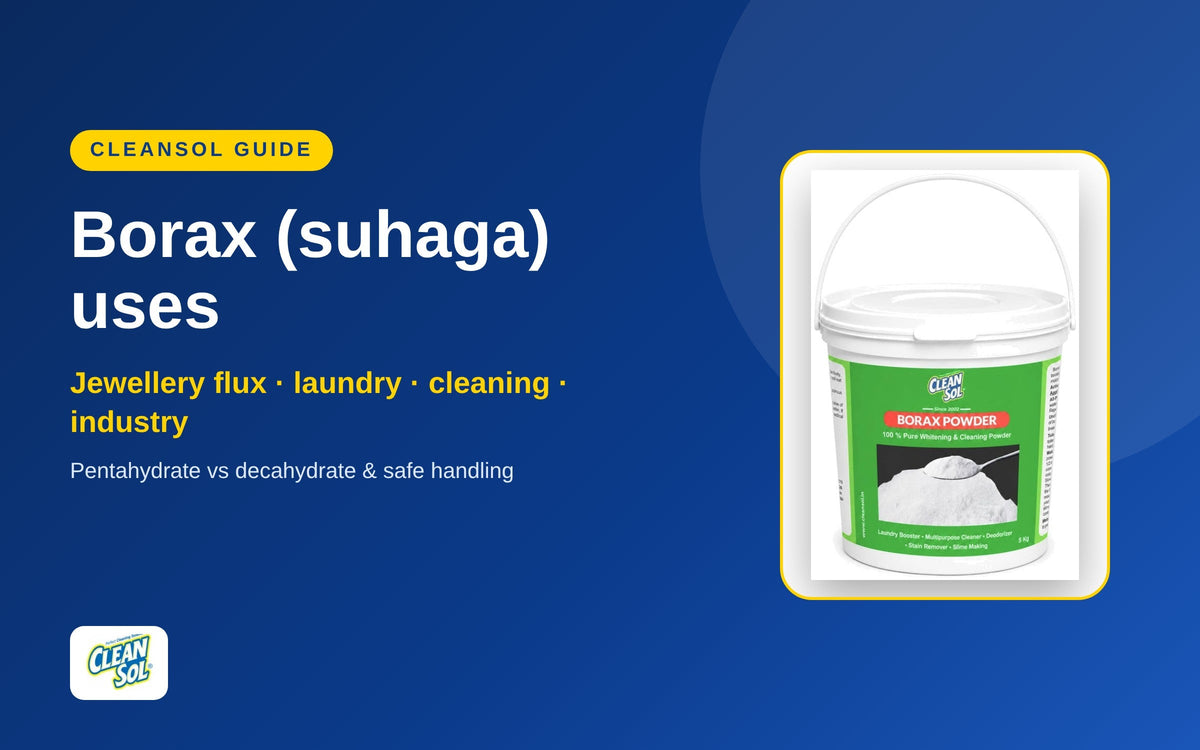
Cleansol Guide · Borax
Borax (suhaga) uses: jewellery flux, laundry, cleaning and industry
Suhaga has been on the goldsmith's bench and in Indian homes for generations. Here is what borax actually is, how to use it for melting and soldering gold and silver, in the laundry and for cleaning – and how to handle it safely.
Pinch
flux per melt
1–2 tbsp
per laundry load
~9.3
pH – mildly alkaline
Never
in food or drinks
Quick answer: Borax (suhaga, sodium borate) is a white mineral salt. Jewellers sprinkle a pinch on gold or silver while melting, or use it as a paste when soldering, to keep the metal clean. At home, 1–2 tablespoons with your detergent help in hard water, and a borax paste cleans sinks and tiles. It is not for food, and the powder should be kept away from children.
In this guide
What is borax (suhaga)?
Borax is sodium borate – a naturally occurring mineral salt, refined into a fine white powder. In India it is known as suhaga, and in older texts as tincal. It dissolves in water to give a mildly alkaline solution (pH about 9.3), and when heated it melts into a clear glass that dissolves metal oxides. Those two properties explain almost every use of borax – from the jeweller's crucible to the washing machine.
🔥 Melts into a flux
Dissolves oxides on hot metal so gold and silver melt and join cleanly.
💧 Mildly alkaline
Softens hard water and helps detergent work better.
🧽 Gentle scrub
Fine powder cleans sinks and tiles without hard scratching.
🏭 Boron source
Used in glass, ceramic glazes, enamel and adhesives.
Pentahydrate vs decahydrate – which borax are you buying?
Borax is sold in two common forms. Both are called "borax" or "suhaga", but they carry different amounts of water locked in the crystal.
| Decahydrate (ordinary) | Pentahydrate (Cleansol) | |
| Formula | Na₂B₄O₇·10H₂O | Na₂B₄O₇·5H₂O |
| Water in crystal | 10 parts | 5 parts |
| Borate per kg | Lower | Higher |
| On heating | Swells and froths more | Melts down faster, less froth |
| In storage | Can lose water and change weight | More stable |
| CAS number | 1303-96-4 | 12179-04-3 |
For jewellers, less froth means a cleaner melt and less flux spilling over the crucible. For industry, more borate per kg means less material to buy, ship and store for the same result.
Borax as a jewellery flux for gold and silver
When gold, silver or brass is heated, its surface reacts with air and forms oxides. Oxides stop metal from flowing together and leave dull, porous spots. Borax melts into a thin glassy layer that dissolves these oxides and shields the metal from air – which is why karigars have used suhaga for centuries.
Melting gold or silver
- Prepare the crucible. Glaze a new crucible by melting a little borax inside it first.
- Add the metal. Place your scrap or grain in the crucible.
- Sprinkle a pinch of borax over the metal before heating, and a little more as it melts.
- Heat until fully molten, swirl gently and pour into the ingot mould.
Soldering
- Clean the joint. Remove grease and dirt from both pieces.
- Make a paste: mix borax powder with a few drops of water.
- Apply the paste on and around the joint and place the solder.
- Heat evenly until the solder flows, then let it cool.
- Remove the flux glass by soaking in hot water or your usual pickle.
Jeweller's tip: use as little borax as needed – too much flux traps bubbles and leaves glassy spots. Work in a ventilated area and avoid breathing the fumes.
Borax in the laundry
In hard water, minerals tie up the detergent and clothes come out dull. A small amount of borax with your detergent softens the water and helps the detergent do its job.
| Use | Dose | How |
| Washing machine | 1–2 tablespoons per load | Add with your usual detergent, top-load or front-load. |
| Bucket wash | 1 tablespoon per bucket | Dissolve in warm water first, then add clothes and detergent. |
| Smelly towels | 1 tablespoon in a bucket of warm water | Soak 30 minutes, then wash as usual. |
For whiter whites and tough stains like tea, curry and sweat, use Cleansol Oxygen Bleach – borax supports the detergent, oxygen bleach lifts the stain. For rust marks on fabric, see how to remove rust stains from clothes.
Cleaning with borax at home
🚰 Sinks & wash basins
Make a paste with a little water, scrub, leave 10 minutes, rinse well.
🧱 Tiles & grout
Scrub with the paste on a damp brush, rinse with clean water.
🚽 Toilet ring
Sprinkle 2 spoons in the bowl, leave overnight, brush and flush.
🧽 Mopping
2 tablespoons in a bucket of warm water for floors.
🗑️ Dustbin smell
Sprinkle a spoon at the bottom of the bin after washing it.
🛁 Drains
A spoon down the drain, then hot water after 30 minutes.
For hard-water scale on taps and tiles, a dedicated cleaner works faster – see how to remove hard water stains from tiles and taps. Always rinse kitchen counters and other food-contact surfaces with clean water after cleaning with borax.
Slime making – the safe way
Borax is the classic slime "activator". It is safe enough for craft when it is used correctly – which means an adult handles the powder.
- An adult dissolves 1 teaspoon of borax in 1 cup of warm water.
- The adult adds the solution to the glue a little at a time, stirring, until it forms slime.
- Children play with the finished slime only under adult supervision.
- Everyone washes hands after play. Do not use on cut or sensitive skin.
Important: never let children handle borax powder, and keep it out of their reach. Slime is not for children under 3 and must never go in the mouth. Throw slime away once it becomes dirty.
Industrial uses of borax
| Industry | What borax does |
| Detergent & cleaning powders | Buffers and softens water, improves cleaning |
| Glass & fibreglass | Lowers melting temperature, adds strength and heat resistance |
| Ceramics & enamel | Part of glazes and frits for a smooth glassy finish |
| Adhesives | Thickens starch and casein glues |
| Metal work | Flux for brazing, welding and refining |
| Micronutrient blends | Source of boron for blenders |
Factories and workshops can order Cleansol Borax in 5 kg and 25 kg packs with GST invoice.
Borax vs boric acid vs washing soda vs baking soda
| Borax | Boric acid | Washing soda | Baking soda | |
| Chemical | Sodium borate | Boric acid | Sodium carbonate | Sodium bicarbonate |
| In water | Mildly alkaline (~9.3) | Weakly acidic | Strongly alkaline (~11) | Very mildly alkaline (~8.3) |
| Main use | Flux, laundry booster, cleaning, industry | Industry, labs | Heavy laundry and degreasing | Mild cleaning, deodorising |
| Same thing? | – | No | No | No |
Safety: do's and don'ts
✓ Do
- Keep the powder away from children and pets
- Wear gloves for long use and wash hands after
- Store closed, in a cool and dry place
- Rinse food-contact surfaces with water after cleaning
- Work in a ventilated area when melting metal
✕ Don't
- Never add borax to food, sweets or drinks
- Don't let children handle the powder
- Pregnant women should avoid handling the powder
- Don't get it in the eyes – rinse with plenty of water if it does
- Don't breathe the dust when pouring large amounts
Frequently asked questions
Buy Cleansol Borax (Suhaga)
Borax pentahydrate – 500 g, 1 kg, 5 kg and 25 kg, GST invoice, dispatched from Jodhpur.
Shop Borax → 💬 WhatsApp 98290 05860For cleaning, laundry, craft, jewellery and industrial use. Not for food or medicinal use. Keep away from children.