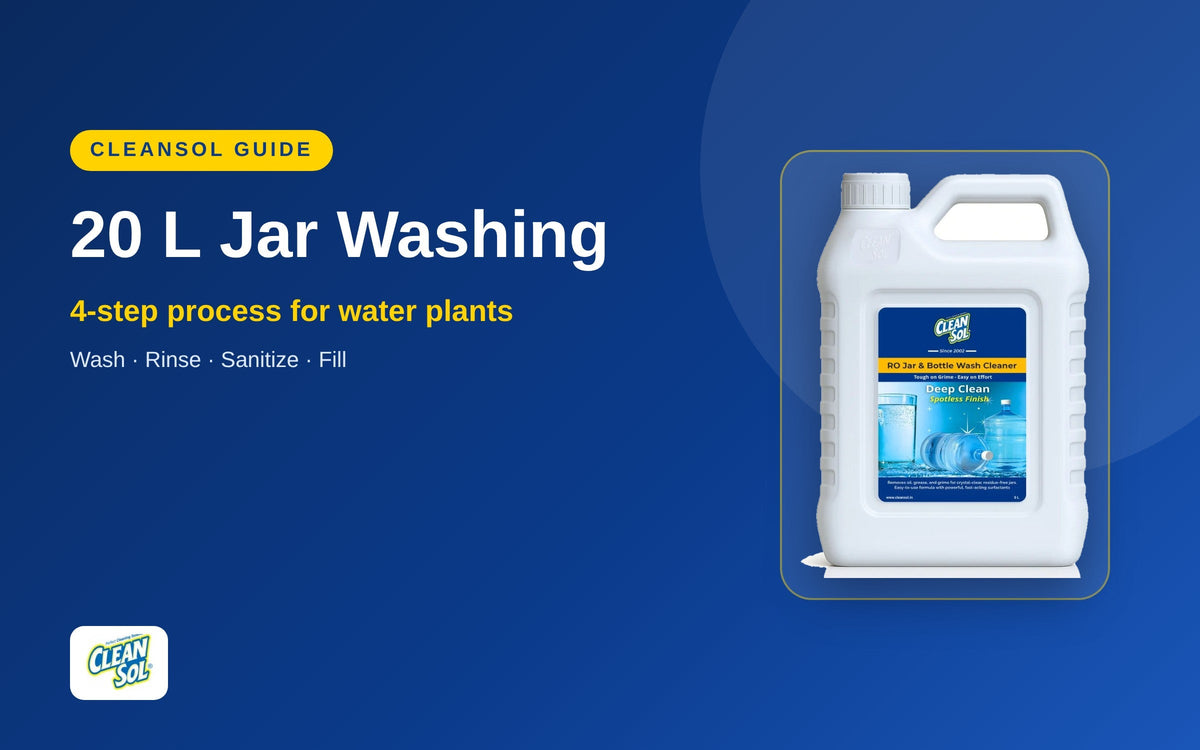
Cleansol Guide · Water Plants
How to wash 20 litre water jars – the 4-step process for RO & packaged water plants
A clean-looking jar is not always a clean jar. Here is the wash, rinse, sanitize and final-rinse process that water plants use, with dilution charts, tank sizes and three simple checks before every fill.
4 steps
wash to fill
25–30 ml
cleaner per litre
100 ppm
chlorine rinse
3 checks
foam · smell · pH
Quick answer
How should a water plant wash 20 L jars? (1) Wash with a neutral-pH jar cleaner at 25–30 ml per litre and brush the walls, neck and base. (2) Rinse 2–3 times with potable water until there is no foam or smell. (3) Sanitize with ozonated water, UV or a 100 ppm chlorine rinse. (4) Final rinse with treated product water, then fill and cap.
In this guide
Why jar washing matters
Returned 20 L jars come back with dust, fingerprints, algae spots and a thin, slippery biofilm on the inside walls and neck. Biofilm protects germs from sanitizers – so if the jar is not properly cleaned first, ozone or chlorine cannot do its job. Good jar washing protects your water quality, your brand and your customers.
The 4-step jar washing process
1
Wash
Pre-rinse to remove loose dirt. Wash with Cleansol RO Water Jar Cleaner at 25–30 ml per litre (warm water is better). Brush the inside walls, neck, shoulder and base, or run the jar through a washing machine.
2
Rinse
Rinse at least 2–3 times with clean potable water until there is no foam and no smell.
3
Sanitize
Use your plant's sanitizing step: ozonated water, UV, or a chlorine rinse of about 100 ppm for 2–5 minutes.
4
Final rinse & fill
Final rinse with treated product water (RO / ozonated), drain, then fill and cap immediately.
Keep cleaning and sanitizing separate. Never mix the jar cleaner and chlorine in the same tank – use them as separate steps with a rinse in between.
Dilution chart & tank sizes
| Water in tank | Jar Cleaner | Approx. jars per fill* |
|---|---|---|
| 10 L bucket | 250–300 ml | manual washing |
| 50 L tank | 1.25–1.5 L | small line |
| 100 L tank | 2.5–3 L | medium line |
| 200 L tank | 5–6 L | machine line |
*Depends on how dirty the jars are. Make a fresh solution every shift and change it as soon as it looks dirty.
Sanitizing options after washing
| Method | How | Notes |
|---|---|---|
| Ozonated water | Rinse with ozonated water from your plant system | Common in packaged water plants |
| UV | Pass the jar or rinse water through a UV system | Works best on a perfectly clean, rinsed jar |
| Chlorine rinse | About 100 ppm: 2 ml Sodium Hypochlorite 5% per litre, 2–5 min | Follow with a final rinse of treated product water |
Whichever method you use, your plant's QA team should validate the full process as per your BIS / FSSAI requirements.
3 quick checks before filling
| Check | How | Pass |
|---|---|---|
| Foam test | Add a little clean water to the rinsed jar and shake | No foam |
| Smell test | Smell inside the jar | No smell |
| pH test | pH strip in last rinse water and in fresh water | Same pH |
If any check fails, rinse again. Never fill a jar that still shows foam or smell.
Manual washing vs jar washing machine
✅ Manual (brush)
- Good for small suppliers
- Brush reaches neck and base well
- Use a 10 L bucket solution, fresh each shift
❌ Watch out for
- Rushing the rinse – the most common cause of foam
- Reusing the same dirty bucket all day
- Skipping the neck and shoulder
For a jar washing machine, add 25–30 ml Jar Cleaner per litre to the machine's wash tank and keep the rinse and sanitize stages running as designed.
6 common jar washing mistakes
| Mistake | Do this instead |
|---|---|
| Filling after one rinse | Rinse 2–3 times until no foam or smell |
| Skipping the sanitize step | Ozone, UV or a 100 ppm chlorine rinse every time |
| Mixing cleaner and hypo in one tank | Separate steps, with a rinse in between |
| Using the same solution all day | Fresh solution every shift |
| Not brushing the neck and base | Brush every surface, or use a machine |
| Using household floor or dish cleaners | Use a jar cleaner made for drinking-water jars |

From the maker
Cleansol RO Water Jar Cleaner
Neutral pH · fragrance-free · rinses clean · 2 L, 5 L, 10 kg, 25 kg, 50 kg · GST invoice.
Shop Jar Cleaner Sodium HypochloriteFrequently asked questions
Running a water plant?
WhatsApp us your daily jar count – we'll suggest the right quantity and send a factory price with GST invoice.
💬 WhatsApp 98290 05860 Get factory price →General guidance for jar washing. Your plant's QA team should validate the complete process as per BIS / FSSAI requirements.