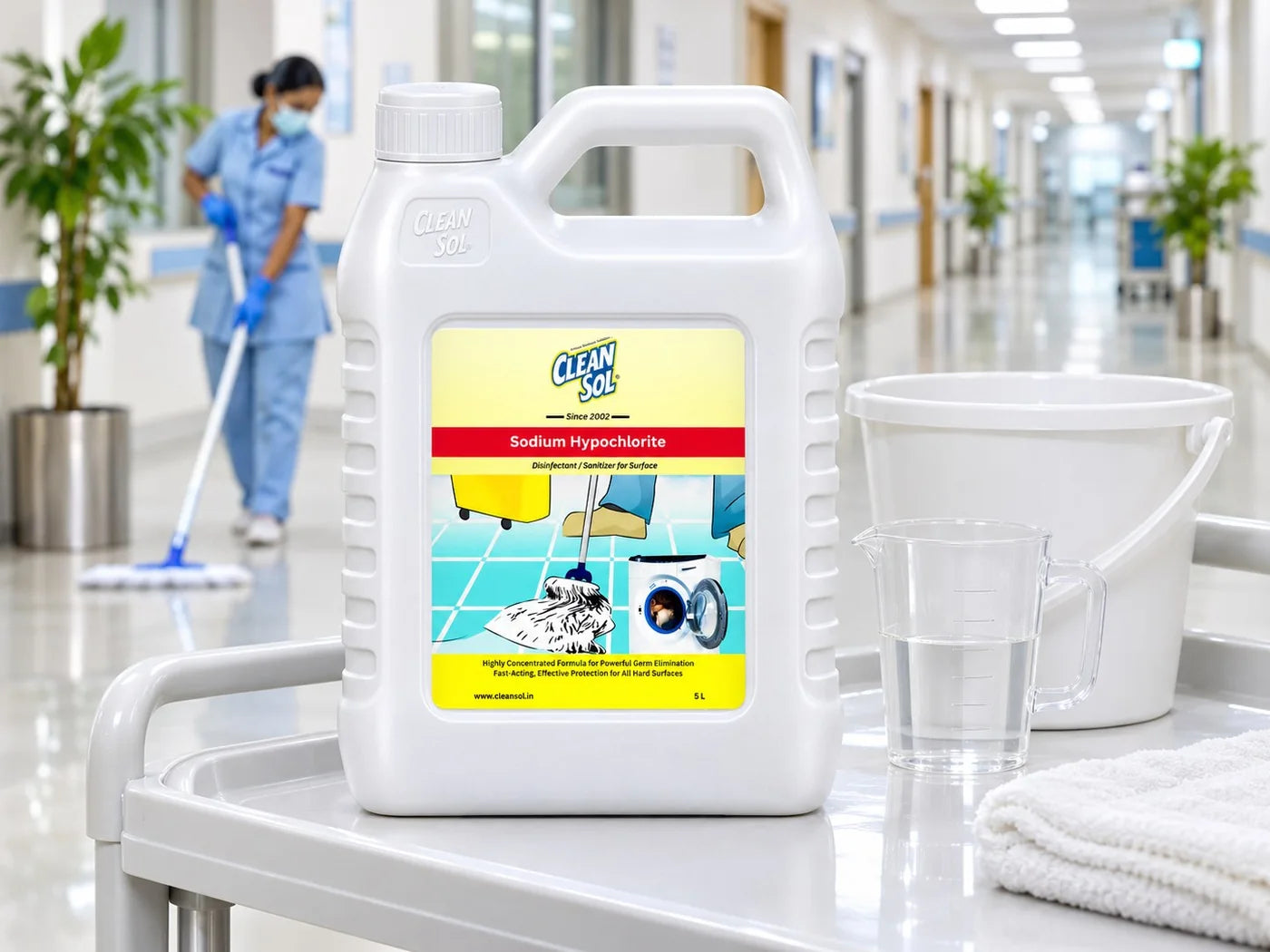
Cleansol Sodium Hypochlorite · below 5% · Since 2002
Don't just clean. Disinfect.The surface disinfectant WHO and India's Health Ministry recommend.
Sodium hypochlorite – liquid chlorine – is the disinfectant hospitals, health authorities and housekeeping teams have relied on for decades. Diluted the right way, it kills bacteria, viruses and fungi on hospital floors, toilets, sick rooms, kennels, sheds and garbage areas. One litre makes up to 50 litres of disinfectant.
≈ 0.1% – the WHO
surface strength
Cleaning is not disinfecting
Your floor cleaner removes dirt. It doesn't kill germs.
A shiny, good-smelling floor can still carry bacteria and viruses. Disinfecting is the second step – and that's the job of sodium hypochlorite.
- Removes dirt, grease and smell
- Adds shine and fragrance
- Germs are mostly washed around – not killed
- Kills bacteria, viruses and fungi
- For hospital floors, toilets, sick rooms, kennels and sheds
- Works in 10 minutes at the right dilution
Dirt protects germs and uses up the chlorine – always clean first. Never mix the two in one bucket.
The right dilution
The right strength for every job
Too weak and germs survive. Too strong and you waste it, damage surfaces and fill the room with fumes. Match the dilution to the job.
Tiled floors, ceramic toilets and sinks, plastic surfaces and dustbins.
Contact time: 10 minutesToilets, washrooms, sick rooms, vomit and blood spills (after wiping up).
Contact time: 10 minutesMopping offices, lifts, lobbies and public toilets; drains, garbage areas, mould on tiles.
Contact time: 10–20 minutesRecommends 0.1% sodium hypochlorite for surfaces – 1 part of 5% hypo to 49 parts water – about our 20 ml in 1 litre.
Uses a 0.5% "strong" chlorine solution for surfaces and body-fluid spills – made fresh every day.
India's Health Ministry advised mopping offices and public places with 1% sodium hypochlorite.
Dilution calculator
How much hypo do I add?
Where to disinfect
One can. Every hygiene-critical place.
 Hospital floors & corridorsWards, OPDs, corridors and spill areas
 Public & hospital toiletsToilet bowls, urinals, tiled floors and walls
 Sick room at homeFloor around the patient’s bed, spills and vomit at 0.5%
 Homes with small childrenTiled floors where children crawl and play
 Pet kennels & sheltersKennel floors, crates and runs – rinse, let dry
 Gaushala & dairy shedsConcrete floors, drains and stall areas
 Poultry farmsFootbaths at the entry, shed floors
 Garbage bins & roomsPlastic bins, garbage rooms and drains
How to disinfect
5 steps – the right way
 1
Wash off dirt with detergent or floor cleaner and rinse.
 2
Wear gloves. Water first, then add the measured hypo.
 3
Wet the whole surface evenly.
 4
Don't wipe dry – contact time kills the germs.
 5
Rinse anything that touches food with clean water.
Quick recipe
One 10 L bucket of everyday disinfectant
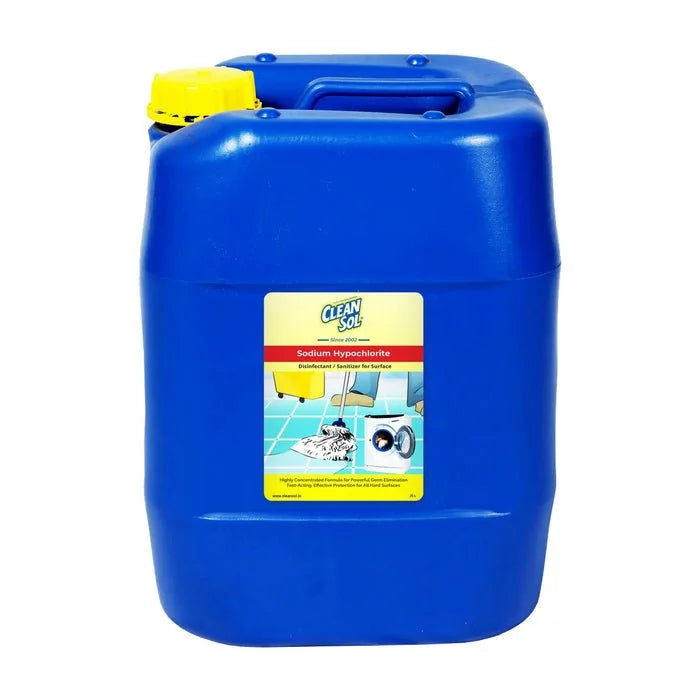
Make it fresh every day – diluted hypochlorite loses strength within 24 hours. One 5 L can makes up to 250 litres.
Watch in 40 seconds
Mix. Mop. Wait 10 minutes.
Why disinfecting fails
6 mistakes that stop it working
Most "it didn't work" complaints come from how the solution is made and used – not the product.
Dirt and grime use up the chlorine. Clean and rinse first.
Germs need contact time. Leave it wet for 10 minutes.
Diluted hypo loses strength, faster in light. Make it fresh every day.
Too weak doesn't kill; too strong damages and fumes. Measure with the chart.
Metal corrodes and weakens the chlorine. Use a plastic bucket.
Mist doesn't reach surfaces long enough. Spray, then wipe or mop.
Safety first
Use it safely
- Acid toilet cleaners, drain cleaners, vinegar → chlorine gas
- Ammonia, glass cleaners, urine → chloramine gas
- Phenyl or any other cleaner
Flush the toilet before disinfecting it, and open windows while you work.
- Taps, steel fittings, door handles – any metal
- Marble and natural stone
- Coloured fabrics, carpets, wood
- Store the can in a cool, shaded place – not on a sunny terrace or near a stove
- Keep the cap tightly closed
- Diluted solution: use within 24 hours
- Wear gloves; keep the room ventilated
- Add hypo to water – never water to hypo
- Make fresh solution daily
- Store closed, cool, away from children and sunlight
What buyers say
Trusted in homes, clinics and shelters
"Product quality and its packaging is wonderful. Potency is very strong, I highly recommend buying sodium hypochlorite from this seller."
Anirban Biswas · Verified purchase"Concentrate, so it can be diluted to the strength required. The bottle arrived on time and in good condition with a double carton packing."
SAP · Verified purchase"Good price and specially useful for people with pets or shelters for animals."
HK · Verified purchaseChoose your size
From one home to a whole hospital
 1 L bottleMakes up to 50 LHomes, small clinics, sick rooms
 2 L canMakes up to 100 LHomes with pets, clinics, small shelters
 5 L canMakes up to 250 LShops, offices, clinics, societies
Hospital, society, hotel or municipal team?
Regular supply at factory price
Regular monthly supply in 5 L cans – GST invoice and pan-India delivery. Tell us your area and we'll work out how much you need.
FAQ
Questions, answered
How much sodium hypochlorite in 1 litre of water?
For everyday disinfection, 20 ml in 1 litre of water (0.1%). For toilets and spills, 100 ml in 1 litre (0.5%).
0.1%, 0.5% or 1% – which should I use?
0.1% (20 ml per litre) for everyday surfaces – the WHO strength. 0.5% (100 ml per litre) for toilets, sick rooms and spills. 1% (200 ml per litre) for deep disinfection of public places, as advised by India's Health Ministry.
Can I just spray it in the air or on people?
No. Spraying the air doesn't disinfect surfaces, and it must never be sprayed on people. Spray or mop the surface, leave it wet for 10 minutes, then wipe.
Is this the same as bleach?
Yes – sodium hypochlorite is the active disinfectant in liquid bleach. Ours is a concentrated solution (below 5%) made for surface disinfection.
Does it kill viruses and bacteria?
Yes. At the right dilution and a 10-minute contact time it kills bacteria, viruses and fungi on clean hard surfaces.
Can I mix it with my floor cleaner or toilet cleaner?
No. Never mix it with acids, toilet cleaners, phenyl or ammonia – it releases toxic gas. Clean first, rinse, then disinfect.
Why make a fresh solution every day?
Once diluted, hypochlorite slowly loses its chlorine. A solution older than 24 hours may be too weak to disinfect.
Can I use it on taps, steel or marble?
No. Sodium hypochlorite corrodes taps, steel fittings, door handles and other metal, and damages marble and natural stone. Use it on tiles, ceramic, concrete and plastic. If it touches metal by mistake, rinse with clean water at once.
How should I store it, and how long does it last?
12 months in the sealed pack. Keep it tightly closed in a cool, shaded place, away from sunlight, children and acids – heat and sunlight weaken it faster.
Why is it below 5%?
Below 5% it is a safe, easy-to-ship surface disinfectant – several states list sodium hypochlorite above 5% under their poison rules. At our strength, 20 ml in 1 litre gives about 0.1%, the WHO surface strength.
Safety: Corrosive – wear gloves and avoid eyes and skin. Never mix with acids or other cleaners. For surface disinfection only – not for drinking or direct use on skin. Keep away from children.