Cleansol Guide · Water Tank
How to use chlorine tablets for water tanks – dose chart, drinking water & safety
Stored water in overhead and underground tanks can grow germs, algae and slime – especially in summer and the monsoon. Here is exactly how many tablets to add for your tank, the milder dose for drinking water, and how to check it is safe.
SDIC
chlorine tablets
5 · 10 · 20 g
tablet sizes
30 min
contact time
0.2–1 mg/L
safe drinking level
Quick answer
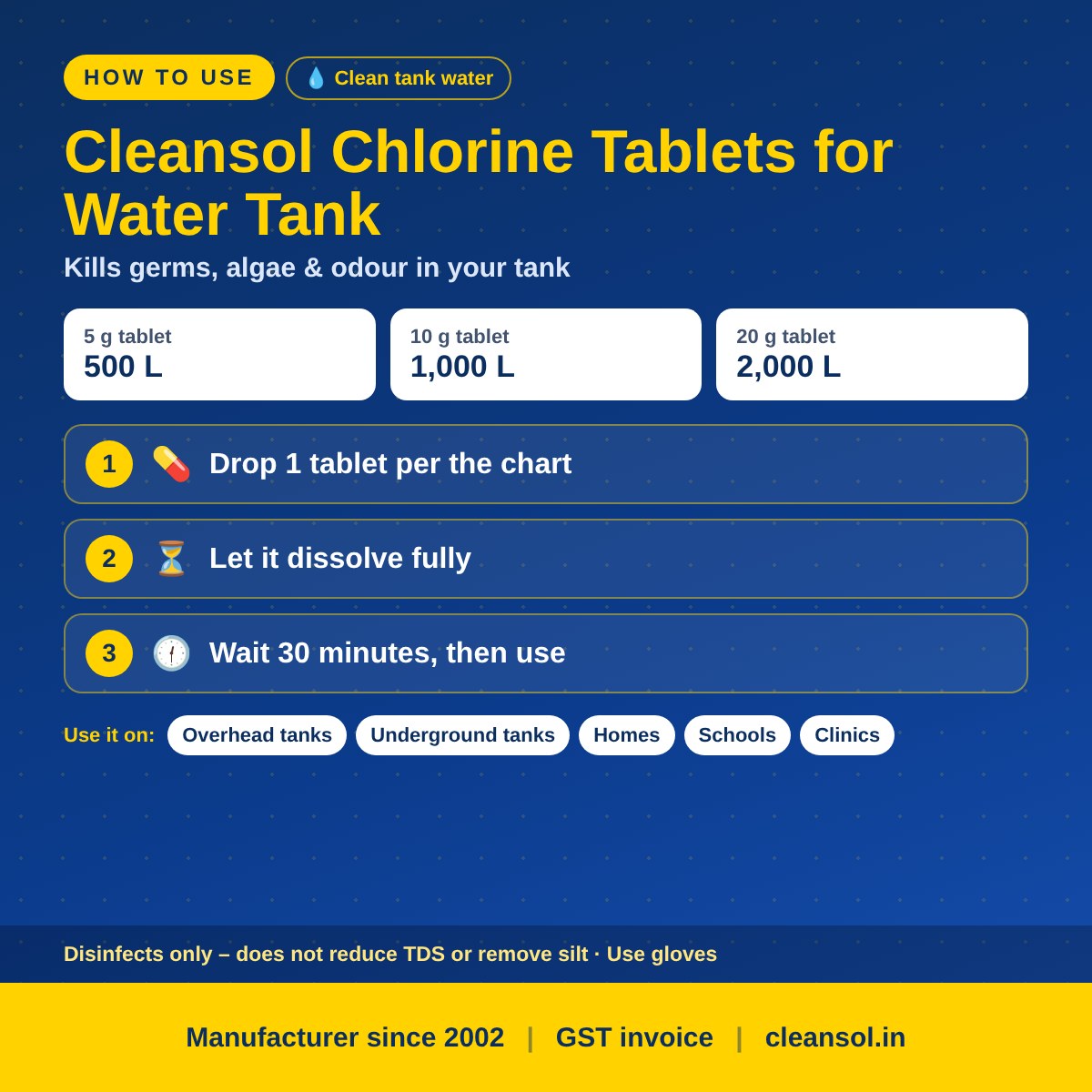
How many chlorine tablets for a water tank? For tank disinfection, use the label dose: 1 × 5 g tablet per 500 litres (1 × 10 g per 1,000 L, 1 × 20 g per 2,000 L). For drinking water, use a milder dose: 1 × 5 g tablet per 1,500–2,000 litres of clear water. Wait at least 30 minutes, and drink only when the chlorine at the tap tests 0.2–1 mg/L.
In this guide
🧮
Not sure how many tablets? Enter your tank size in our free calculator – it shows the dose for tank disinfection and for drinking water, and can even measure your tank.
Open water tank calculator →What chlorine tablets do – and what they don't
Cleansol chlorine tablets are made of SDIC (sodium dichloroisocyanurate), a chlorine-releasing compound widely used for water disinfection. They dissolve slowly and release chlorine that kills germs in the stored water.
✅ They do
- Kill bacteria, viruses and algae in stored water
- Control bad smell and slimy build-up in the tank
- Leave a small chlorine residual that protects water in the pipes
- Work in overhead, underground and loft tanks
❌ They don't
- Reduce TDS, hardness or salts – use RO for that
- Remove mud, sand, silt or rust – filter or clean the tank
- Remove heavy metals, fluoride, arsenic or chemicals
- Make muddy water clean – chlorine works best on clear water
Dose 1 – Tank disinfection (label dose)
Use this dose to disinfect a tank after cleaning, when the water smells, or for water used for washing, bathing and cleaning. The rule is 1 g of tablet per 100 litres of water.
| Water in the tank | Tablets to add |
|---|---|
| 500 L | 1 × 5 g |
| 1,000 L | 1 × 10 g |
| 1,500 L | 1 × 10 g + 1 × 5 g |
| 2,000 L | 1 × 20 g |
| 3,000 L | 1 × 20 g + 1 × 10 g |
| 5,000 L | 2 × 20 g + 1 × 10 g |
| 10,000 L | 5 × 20 g |
Dose 2 – Drinking water (milder dose)
For water you will drink or cook with, use a much lower dose so the chlorine stays within safe limits: 1 × 5 g tablet per 1,500–2,000 litres of clear water.
| Water in the tank | Tablets to add |
|---|---|
| 1,500–2,000 L | 1 × 5 g |
| 3,000–4,000 L | 1 × 10 g |
| 5,000–6,000 L | 3 × 5 g |
| 10,000 L | 3 × 10 g |
Tank smaller than 1,500 L? Even one 5 g tablet is stronger than drinking strength for a 500 or 1,000 L tank. Add one tablet, let the water stand and use it for washing and bathing first. Drink only after a chlorine test kit reads 0.2–1 mg/L at the tap, or the chlorine smell has gone.
Count only the water actually in the tank – a 1,000 L tank that is half full holds 500 L.
How to use chlorine tablets – step by step
Clean the tank first if it has sludge. Chlorine cannot work through mud and slime. Wash the empty tank once – see our bleaching powder tank cleaning guide.
Fill the tank and note how many litres of water it holds.
Choose your dose – tank disinfection or drinking water – from the charts above or the calculator.
Wearing dry gloves, drop the tablets into the water. Do not drop them onto metal fittings or pipes.
Let them dissolve completely, then wait at least 30 minutes before using the water.
Re-treat only when fresh, untreated water is added – for example after a tanker or rainwater refill. Don't keep adding tablets to the same water.
💡
Rainwater and borewell tip: pass the water through a mesh and sand/carbon filter before it reaches the tank. Clear water needs less chlorine and is disinfected far more reliably.
Is the water safe to drink after treatment?
Chlorine tablets disinfect water – they kill germs. Whether water is safe to drink also depends on its chemical quality (TDS, hardness, fluoride, metals, nitrates) and its chlorine level. Follow these limits:
| Check | Guideline | Reference |
|---|---|---|
| Minimum free chlorine at the tap | 0.2 mg/L (0.5 mg/L when protection against viruses is needed) | BIS IS 10500:2012 |
| Maximum free chlorine at the tap | 1 mg/L | BIS IS 10500:2012 |
| Free chlorine – health guideline | Should not normally exceed 5 mg/L | WHO Guidelines for Drinking-water Quality |
| SDIC in water | Use the lowest dose that disinfects; avoid repeated topping-up | WHO chemical fact sheet – sodium dichloroisocyanurate |
- Test at the tap with a simple chlorine test kit (OTO/DPD drops, available at chemists and water-treatment shops). Drink only when it reads 0.2–1 mg/L.
- Strong chlorine smell? The level is too high – wait longer and use the water for washing first.
- For drinking and cooking, pass the water through an RO/UV purifier and get it tested once at a water-testing lab – especially rainwater, borewell or tanker water.
Important: Cleansol cannot guarantee that your water is safe to drink, because that depends on the source water. These tablets are a disinfectant. Please follow the checks above and the advice of your local water authority or a water-testing lab.
Troubleshooting
Strong chlorine smell
Too many tablets for the water, or used too soon. Wait a few hours; next time check the litres and use the right dose.
Smell or slime comes back
The tank has sludge or algae on the walls. Drain, scrub, rinse and dose again.
Water looks muddy or yellow
Chlorine doesn't remove dirt or iron. Filter the water or clean the tank.
Tablet not dissolving
Normal – they dissolve slowly. Wait until fully dissolved before using the water.
Safety and storage
✅ Do
- Handle tablets with dry gloves.
- Keep in the closed original container, cool and dry, away from sunlight.
- Rinse skin or eyes with plenty of water if contact occurs.
❌ Don't
- Never mix with acids, toilet cleaners or other chemicals – it releases chlorine gas.
- Don't touch tablets with wet hands.
- Keep away from children and pets. Not to be swallowed.

From the maker
Cleansol Chlorine Tablets for Water Tank
SDIC tablets in 5 g, 10 g and 20 g · slow-dissolving · no measuring · GST invoice · pan-India delivery.
Shop Chlorine Tablets Water tank calculatorFrequently asked questions
Tablets for a society, school or hotel?
WhatsApp us your tank sizes and how often they are filled – we'll suggest the right quantity and send a bulk price with GST invoice.
💬 WhatsApp 98290 05860 Get factory price →References: WHO, Guidelines for Drinking-water Quality; WHO, Sodium dichloroisocyanurate – chemical fact sheet; Bureau of Indian Standards, IS 10500:2012 Drinking Water – Specification. Safety: read the label before use. Keep out of reach of children.